
Helping Your Toddler Speak Through Imitation Therapy
 By Speech Blubs Team•Mar 9, 2026•14 min.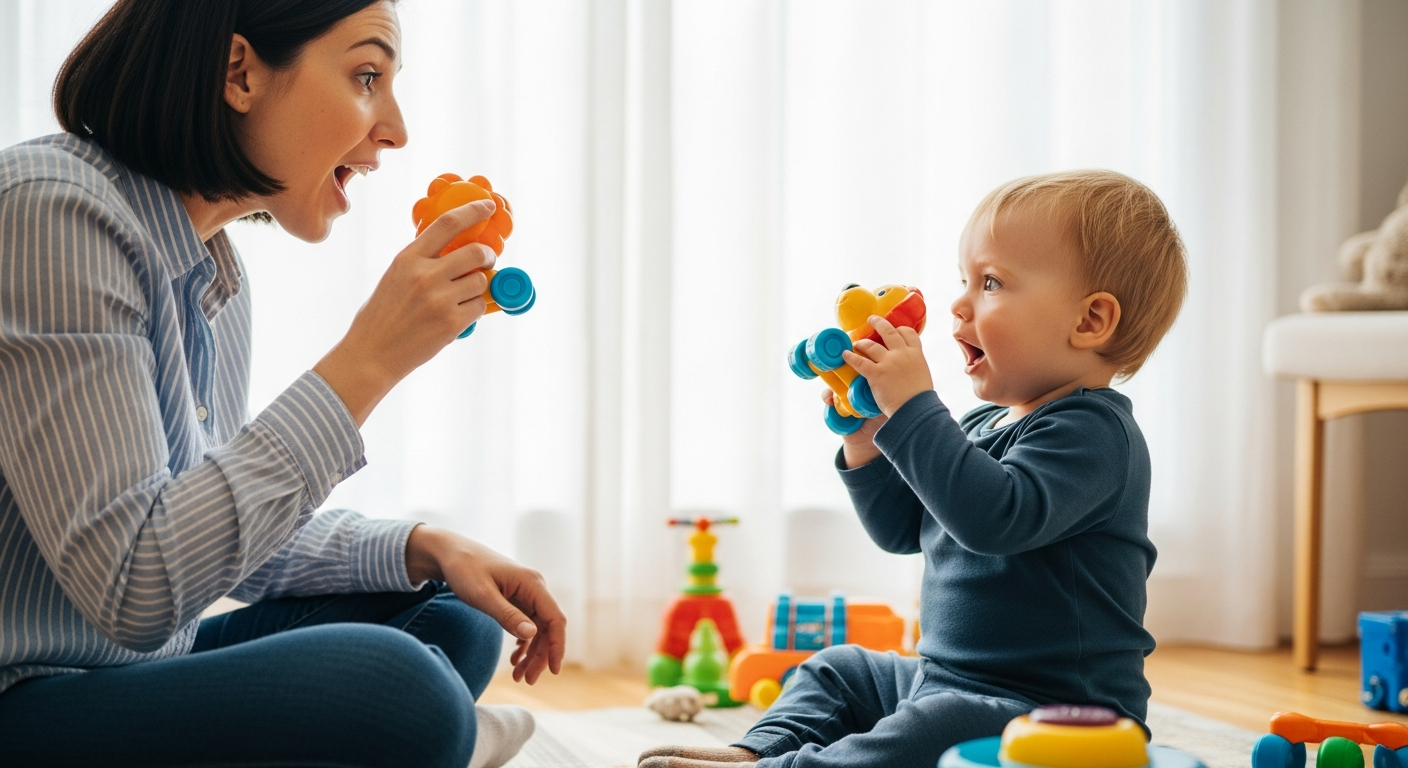
Table of Contents
- Introduction
- Understanding the Difference: Speech vs. Language
- Why Imitation is the Foundation of Learning
- The Imitation Hierarchy: A Step-by-Step Roadmap
- Recognizing the Signs of a Delay
- How Delayed Imitation Speech Therapy Works
- Practical Strategies to Encourage Imitation at Home
- Fostering Joy, Not Frustration
- Investing in Your Child’s Future
- Conclusion
- Frequently Asked Questions
Introduction
Imagine the moment you realize your toddler isn’t just looking at you—they are studying you. You clap your hands, and they try to bring their tiny palms together. You make a silly "fish face," and they scrunch their lips in an adorable attempt to match yours. This isn't just a cute game of follow-the-leader; it is the absolute engine of human development. For many parents, however, there comes a point where that natural mirroring seems to stall. Perhaps your little one isn't mimicking the sounds of the family dog, or they aren't waving "bye-bye" when grandma leaves. When these mirroring milestones don't appear on schedule, it can lead to concerns about a speech delay.
At Speech Blubs, we understand the weight of that concern. Our mission is to empower children to "speak their minds and hearts," a goal born from the personal experiences of our founders. Having grown up with speech challenges themselves, they set out to create the joyful, effective tool they wish they’d had as children. We believe that communication is the bridge to connection, and for the 1 in 4 children who need extra support, delayed imitation speech therapy often serves as the first essential step across that bridge.

In this post, we will explore the critical role of imitation in language acquisition. We will dive deep into the "Imitation Hierarchy," identify the red flags of a delay, and provide practical, play-based strategies you can use at home. Most importantly, we’ll show you how to transform "screen time" into "smart screen time" to support your child's unique journey. By the end of this guide, you will have a clear roadmap for fostering your child’s confidence and a love for communication through the power of peer-led learning.
Understanding the Difference: Speech vs. Language
Before we dive into the specifics of imitation, it’s helpful to clarify two terms that are often used interchangeably: speech and language. While they are closely related, they represent different parts of the communication puzzle.
Speech is the physical act of producing sounds. It involves articulation (how we form words with our mouth and tongue), voice (using our vocal cords and breath), and fluency (the rhythm of our talk). If a child has a speech delay, they might know exactly what they want to say but struggle to physically coordinate the muscles needed to make the sounds clear.
Language, on the other hand, is the system of symbols—words, signs, or pictures—we use to share meaning. This includes receptive language (what a child understands when others speak) and expressive language (how a child uses words or gestures to communicate their own needs and thoughts).
A child experiencing a delay in imitation often sits at the intersection of these two categories. Imitation is the primary way children learn both the physical "how-to" of speech and the social "why" of language. If you are feeling uncertain about where your child stands, we recommend taking our quick 3-minute preliminary screener. It involves just 9 simple questions and provides an immediate assessment and a next-steps plan to give you peace of mind.
Why Imitation is the Foundation of Learning
Imitation is the cornerstone of all human learning. From the way we hold a spoon to the complex nuances of a conversation, we learn by watching others. For a toddler, imitation is their first "social superpower." It allows them to participate in the world before they have the vocabulary to describe it.

When a child observes an action, specific cells in their brain called "mirror neurons" fire as if they were performing the action themselves. This neurological "rehearsal" is why video modeling is so effective. At Speech Blubs, we leverage this exact scientific principle. Our app features videos of real children—peers—performing speech sounds and actions. Watching a peer, rather than an adult, creates a more relatable and motivating "model" for your child to copy.
Delayed imitation speech therapy focuses on strengthening this mirroring ability. If a child isn't imitating motor movements (like clapping) or sounds (like "vroom"), they may struggle to eventually imitate the complex mouth movements required for words. By focusing on imitation first, we build the foundational "muscles" of communication.
The Imitation Hierarchy: A Step-by-Step Roadmap
Speech and language development doesn't happen all at once; it follows a predictable path. In the world of delayed imitation speech therapy, we use the "Imitation Hierarchy" to determine where a child currently is and what the next reachable goal should be.
Phase 1: Imitation With Objects
This usually begins between 9 and 16 months. A child learns to copy an action using a toy or object. If you push a toy car, they push the toy car. If you put a hat on your head, they try to put a hat on theirs.
Pro-tip: For a parent whose toddler loves vehicles, the "Beep Beep" section of the Speech Blubs app offers a fantastic way to bridge this gap. You can watch a peer make a car sound, and then use a physical toy car at home to "vroom" together.
Phase 2: Imitation of Body Movements
Next, children move to "gross motor" imitation. This includes big movements like waving hello, clapping, or reaching up to be held. These gestures are the first "words" a child uses to communicate their intentions to the world.
Phase 3: Imitating Facial Expressions and Mouth Movements
This is a critical bridge to speech. In this phase, children copy smiles, stuck-out tongues, or "fishy lips." It shows they are paying attention to the mouth—the place where speech sounds are made. This is where our "Face Filters" in the app shine. By turning your child into a lion or a robot using AR technology, we encourage them to look at their own mouth movements in a mirror-like experience, making facial imitation a joyful game.
Phase 4: Vocalizations in Play
Before a child says "cow," they usually say "moo." This phase is about non-speech sounds: animal noises, car engines, or the "uh-oh" when a block tower falls. These sounds are easier to produce than words because they are often repetitive and fun.
Phase 5: Exclamatory Words
Words like "Yay!", "Wow!", or "Boom!" carry a lot of emotional weight and intonation. Children are often more motivated to imitate these high-energy words because they get a big reaction from the adults around them.
Phase 6: Verbal Routines
This involves completing a familiar pattern. If you say, "Ready, set..." and pause, your child might chime in with "...go!" Or, during a song like "Twinkle, Twinkle, Little...", they might provide the word "Star." This shows they are anticipating and participating in the rhythm of language.
Phase 7: Functional Words
Finally, we reach the stage of imitating specific, meaningful words like "Mama," "Ball," "Milk," or "More." These words allow the child to get their needs met, proving that communication is a powerful tool.
Recognizing the Signs of a Delay
While every child develops at their own pace, there are specific "red flags" regarding imitation that suggest a child might benefit from extra support. You should consider consulting a professional or exploring supplemental tools if your child:
- By 12 months: Does not use gestures like pointing or waving.
- By 18 months: Prefers using gestures exclusively over making any vocal sounds or has significant trouble imitating simple actions.
- By 24 months: Can only imitate speech or actions but cannot produce any words or phrases spontaneously.
- At any age: Seems to "lose" skills they once had or doesn't seem to hear you when you speak.
If you find yourself nodding along to these points, know that you are not alone. Our testimonials page is filled with stories from parents who were in your exact shoes and found a way forward by integrating Speech Blubs into their daily routine.
How Delayed Imitation Speech Therapy Works
When a Speech-Language Pathologist (SLP) works with a child on imitation, they aren't just asking the child to "say this." They are creating an environment where the child wants to copy. This often involves:
- Following the Child's Lead: If the child is playing with a ball, the therapist plays with a ball.
- Imitating the Child First: To get a child to copy you, you often have to copy them! If they bang on the table, you bang on the table. This creates a "back-and-forth" social loop.
- Exaggeration: Using a "sing-song" voice (parentese) and big facial expressions to make the model easier to see and hear.
- Visual Support: Using mirrors, videos, or pictures to reinforce the sound.
This is why we focus so heavily on video modeling. Our research-based methodology puts these clinical strategies into a format that children actually enjoy. Instead of a "lesson," it feels like a playdate with a new friend on the screen.
Practical Strategies to Encourage Imitation at Home
You are your child's most important teacher. You don't need a clinical degree to provide effective delayed imitation speech therapy at home. Here are some of our favorite ways to weave learning into your day:
Use the "Trifecta" of Learning
When you want your child to imitate a sound, try to engage three senses:
- See: Get face-to-face. Let them see how your lips move to make a "P" sound (like a little puff).
- Hear: Use a slightly higher pitch and repeat the sound clearly.
- Feel: Put your child’s hand on your cheek or near your mouth so they can feel the vibration of the "M" sound or the puff of air from a "B."
Narrate Your Life (Parallel Talk)
Think of yourself as a sports commentator for your child's life. Instead of asking questions ("What are you doing?"), describe what they are doing: "You are pushing the car. Vroom, vroom! The car is going fast!" This removes the pressure to perform and provides a rich environment of sounds for them to eventually mimic.
The Power of Symbolic Play
Encourage your child to use objects to represent other things. A banana becomes a phone; a cardboard box becomes a rocket ship. Symbolic play is deeply linked to language because it requires the brain to understand that one thing can "stand for" another—just like a word stands for an object.
Make Screen Time "Smart"
Not all screen time is created equal. While passive cartoons can be a fun break, they don't require the child to participate. Speech Blubs is designed to be a "screen-free alternative" in spirit—meaning it’s an active, participatory experience. We encourage parents to sit with their children, watch the peer models together, and join in the fun.
Ready to see the difference for yourself? You can download Speech Blubs on the App Store or get it on Google Play today to start your journey.
Fostering Joy, Not Frustration
The most important ingredient in any speech therapy journey is joy. If a child feels pressured to speak, they may shut down. Our goal at Speech Blubs isn't to turn your living room into a classroom, but to create "joyful family learning moments."
When your child makes an attempt to imitate—even if it’s not perfect—celebrate it! If they try to say "bottle" and it sounds like "ba," give them the bottle and say, "Yes, bottle! You told me what you wanted!" This positive reinforcement builds the confidence they need to keep trying.
We don't promise that your child will be giving public speeches in a month. Every child’s path is unique. However, by focusing on the benefits of the process—building foundational skills, reducing frustration, and fostering a love for communication—you are setting them up for long-term success.
Investing in Your Child’s Future
We believe that every child deserves the best possible start, which is why we’ve made our pricing transparent and accessible. We want you to have all the tools you need to support your child’s development without any guesswork.
We offer two main ways to join the Speech Blubs family:
- Monthly Plan: For $14.99 per month, you get full access to our library of 1,500+ activities.
- Yearly Plan (Best Value): For only $59.99 per year, which breaks down to just $4.99 per month.
The Yearly plan is our most popular choice for a reason. Not only do you save 66% compared to the monthly rate, but you also receive exclusive high-value features that aren't included in the monthly option. When you choose the Yearly plan, you get:
- A 7-day free trial to explore everything we have to offer.
- The Reading Blubs app, a dedicated tool to help your child transition from speaking to reading.
- Early access to all new updates and features.
- Priority 24-hour support response time from our dedicated team.
By choosing the Yearly plan, you aren't just buying an app; you're investing in a comprehensive developmental ecosystem for your child. You can create your account and start your 7-day free trial today.
Conclusion
Delayed imitation speech therapy is about more than just words; it’s about giving your child the keys to unlock their own world. Whether it starts with a simple clap, a funny face, or a whispered "moo," every act of imitation is a victory. It’s a sign that your child is reaching out, trying to connect, and learning how to share their heart with you.
At Speech Blubs, we are honored to be a part of that journey. Our peer-led video modeling, backed by science and fueled by play, is designed to make those first steps easier and much more fun. Remember to focus on the small wins, stay patient, and keep the environment light and encouraging.
Take the first step today. Download Speech Blubs on the App Store or Google Play and see how peer-to-peer learning can transform your child's communication. For the best experience and the greatest value, we highly recommend selecting our Yearly plan. This ensures you get the 7-day free trial, the Reading Blubs app, and the peace of mind that you have a full year of support for your child’s growing voice. Let's work together to help your little one speak their mind and heart!
Frequently Asked Questions
1. What is the "Video Modeling" used in Speech Blubs?
Video modeling is a scientific method where a child learns a behavior or skill by watching a video of someone else performing it. At Speech Blubs, we use "peer modeling," which means your child watches other children their age. Research shows that toddlers are significantly more motivated to imitate children than adults. It builds their confidence because they see someone "just like them" succeeding at making a sound or saying a word.
2. My child is already in professional speech therapy. Can I still use Speech Blubs?
Absolutely! In fact, many Speech-Language Pathologists recommend Speech Blubs as a powerful supplement to professional therapy. Think of it like "homework" that your child actually wants to do. It provides the extra repetition and practice needed between therapy sessions to help reinforce the skills they are learning with their therapist.
3. How much screen time is recommended for Speech Blubs?
We recommend "smart screen time" in short, impactful bursts—usually about 5 to 15 minutes a day. The key is to make it an active experience. Sit with your child, mirror the sounds they hear in the app, and use the "Face Filters" to turn it into a physical game. Our goal is to use the screen as a bridge to real-world interaction, not a replacement for it.
4. What if my child doesn't start talking immediately after using the app?
It's important to set realistic expectations. Speech development is a marathon, not a sprint. Some children may start imitating sounds within days, while others may take weeks to build the foundational skills like eye contact and gross motor imitation first. Focus on the "pre-linguistic" wins: Is your child looking at the screen more? Are they trying to smile back at the kids? Are they making more "vroom" or "uh-oh" sounds during play? These are all signs of progress!
About the author