
Is Montessori Good for Speech Delay? Benefits & Tips
 By Speech Blubs Team•Mar 12, 2026•14 min.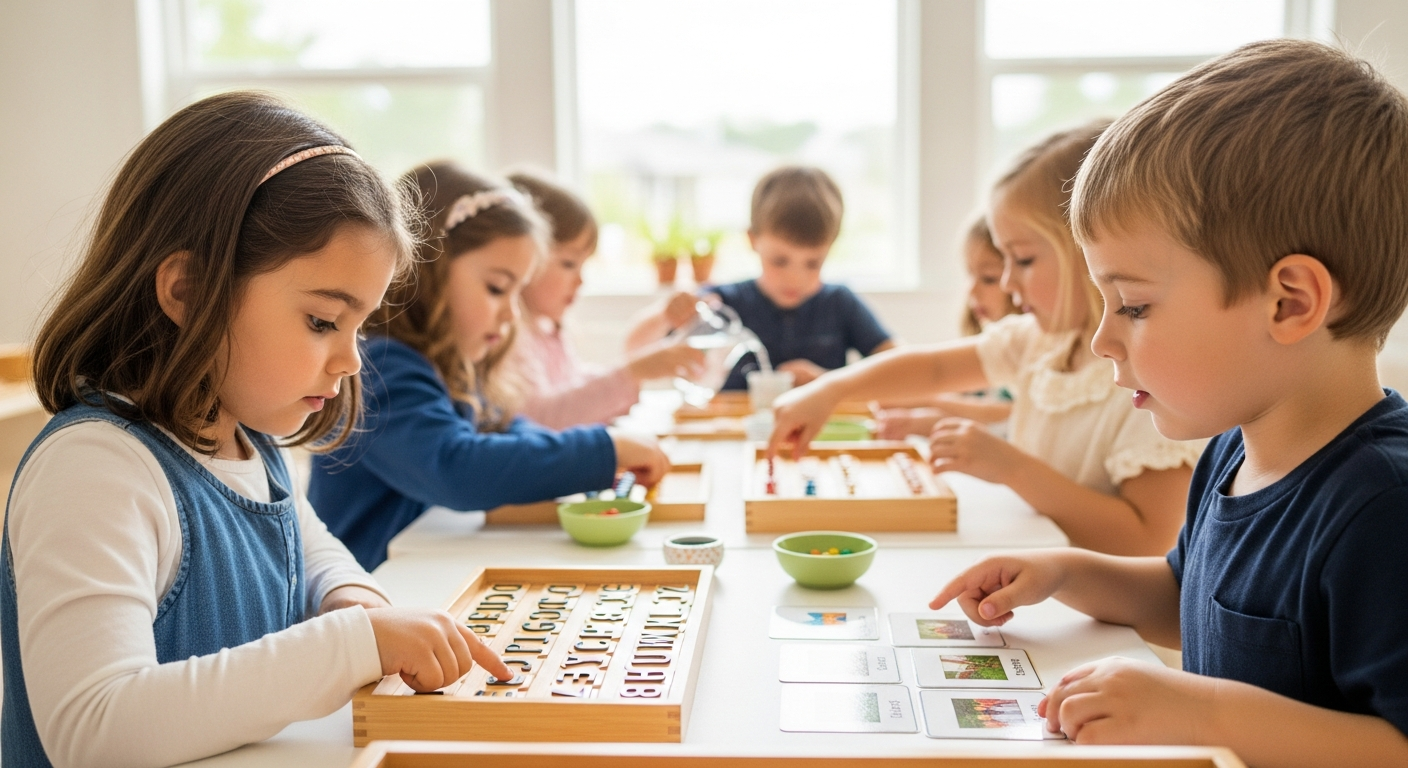
Table of Contents
- Introduction
- Understanding the Montessori Philosophy
- The "Sensitive Period" for Language
- Peer Modeling: The Power of Watching Others
- The Connection Between Fine Motor Skills and Speech
- Is Montessori Good for Speech Delay? The Benefits
- Practical Scenarios: Montessori Meets Speech Blubs
- Potential Challenges to Consider
- Integrating Speech Blubs into a Montessori Lifestyle
- Bringing Montessori Principles Home
- The Role of Professional Therapy
- How to Choose a Montessori School for a Child with Speech Delay
- Setting Realistic Expectations
- Conclusion
- Frequently Asked Questions
Introduction
Imagine walking into a room where every object is perfectly sized for a three-year-old. The shelves are low, the colors are calming, and there is a profound sense of quiet focus. A child carefully pours water from a small pitcher into a glass, narrating their actions with a soft whisper. For parents of children with speech delays, this scene can feel both beautiful and a bit daunting. You might find yourself wondering: "Is this calm, self-directed environment enough to help my child find their voice? Is Montessori good for speech delay, or does my child need something more structured?"
At Speech Blubs, we understand these questions because we’ve been there. Our founders grew up with speech challenges and created the tools they wished they had to speak their minds and hearts. We believe that every child deserves a joyful, effective path to communication. This blog post will explore the intersection of the Montessori philosophy and language development. We will dive deep into how child-led learning, sensory-rich environments, and peer modeling can support a child with a speech delay. We will also discuss how to integrate specialized tools like our app to create a comprehensive support system.

By the end of this article, you will have a clear understanding of the benefits and considerations of the Montessori method for speech delays, practical strategies to use at home, and how to choose the right educational path for your little one.
Understanding the Montessori Philosophy
To answer if Montessori is good for speech delay, we must first look at what makes this method unique. Developed by Dr. Maria Montessori in the early 1900s, this educational approach is built on the belief that children are naturally curious and capable of initiating their own learning.
In a Montessori environment, the teacher acts as a "guide" rather than a lecturer. The classroom is a "prepared environment" designed to facilitate independence. For a child with a speech delay, this shift in dynamic can be transformative. Traditional classrooms often rely heavily on verbal instructions and group-wide pacing. In contrast, Montessori allows a child to move at their own rhythm, reducing the anxiety that often accompanies communication struggles.
We often see that frustration is the biggest barrier to speech. When a child can't express their needs, they may shut down or act out. The Montessori method addresses this by providing "Practical Life" activities. These are everyday tasks—like buttoning a coat or slicing a banana—that give a child a sense of mastery and confidence. This confidence is the bedrock upon which language is built.
The "Sensitive Period" for Language
Dr. Montessori identified what she called "sensitive periods"—windows of time when a child is biologically primed to acquire specific skills with ease. The sensitive period for language is the longest, lasting from birth until about age six.
During this time, a child’s brain is like a sponge, absorbing the sounds, rhythms, and structures of the language spoken around them. For a child with a speech delay, this period is critical. Montessori education maximizes this window by immersing the child in a language-rich environment.
Unlike passive screen time—such as watching cartoons—the Montessori approach requires active engagement. At Speech Blubs, we mirror this philosophy by offering "smart screen time." Our app is designed to be a screen-free alternative to passive viewing, encouraging children to interact, imitate, and participate. If you are curious about where your child stands in their development, you can take our quick 3-minute preliminary screener to get a simple assessment and a free 7-day trial.

Peer Modeling: The Power of Watching Others
One of the most effective components of the Montessori method is the mixed-age classroom. Typically, children are grouped in three-year spans (e.g., ages 3 to 6). This allows younger children to observe and learn from their older peers.
This "peer modeling" is exactly why Speech Blubs is so effective. Our app uses a unique video modeling methodology, where children learn by watching other children perform speech exercises. When a child sees a peer making a "b" sound or saying "apple," their mirror neurons fire, making them much more likely to attempt the sound themselves.
In a Montessori classroom, a child with a speech delay isn't just listening to an adult; they are watching a slightly older friend navigate a conversation or name an object. This reduces the "authority gap" and makes communication feel attainable and fun.
The Connection Between Fine Motor Skills and Speech
It might seem surprising, but the way a child uses their hands is closely linked to how they use their tongue and lips. Research suggests that the areas of the brain responsible for fine motor skills and language functions are interconnected.
Montessori education places a heavy emphasis on "hand work." Activities such as:
- Using tweezers to move beads
- Tracing "Sandpaper Letters" with fingers
- Pouring and scooping
- Polishing silver or wood
These tasks refine the child’s dexterity and hand-eye coordination. By strengthening these neural pathways, Montessori indirectly supports the neurological foundation needed for speech. When a child works with their hands, they are literally building their brain for better communication.
Is Montessori Good for Speech Delay? The Benefits
When parents ask, "Is Montessori good for speech delay?" we often point to these specific benefits:
1. Reduced Pressure and Anxiety
Children with speech delays are often acutely aware that they are "behind." In a traditional setting, being called on to answer a question can be terrifying. Montessori removes the spotlight. Because learning is individualized, there is no "standard" pace to fall behind. This lack of pressure allows the child’s natural desire to communicate to surface without fear of failure.
2. Sensory-Rich Language Learning
Language in Montessori isn't just about hearing words; it's about feeling them. The "Sandpaper Letters" allow a child to feel the shape of a letter while hearing its sound. Phonetic puzzles and storytelling baskets use physical objects to represent abstract words. This multi-sensory approach is incredibly helpful for children who struggle with traditional auditory-only learning.
3. Intentional Vocabulary Building
Montessori guides are trained to use precise, descriptive language. Instead of saying, "Put that thing over there," they might say, "Please place the small ceramic pitcher on the wooden tray." This exposes the child to a vast and specific vocabulary in context, helping them connect words to real-world objects and actions.
Practical Scenarios: Montessori Meets Speech Blubs
To see how this works in real life, let’s look at a few scenarios.
Scenario A: The Animal Lover For a parent whose 3-year-old "late talker" loves animals, a Montessori home might have a basket of realistic animal figurines. The parent might sit with the child and name each one: "This is a cow. The cow says moo." To supplement this, the parent can open the "Animal Kingdom" section of Speech Blubs. Here, the child sees a peer making the "moo" sound while wearing a fun cow filter. The combination of the physical figurine and the digital peer modeling creates a powerful, motivating way to practice sounds. You can download Speech Blubs on the App Store to explore these categories.
Scenario B: The Kitchen Helper In a Montessori setting, a child might help wash vegetables. The parent describes the sensations: "The water is cold. The tomato is smooth." After the activity, they might use the "Yummy Tummy" section of the app to reinforce food-related words. Seeing another child "eat" a digital apple or say "banana" validates the vocabulary they just experienced in the kitchen. This bridge between real-life experience and "smart screen time" is what sets our approach apart.
Potential Challenges to Consider
While there are many pros, it is important to have realistic expectations. Montessori is a philosophy, not a medical intervention.
- Specialized Support: Not all Montessori schools have a Speech-Language Pathologist (SLP) on staff. If your child has a significant delay or a diagnosed disorder (like apraxia or autism), they will still need professional therapy.
- Teacher Training: Montessori training varies. It is crucial to ask if the guides have experience working with children who have communication challenges.
- The "Quiet" Factor: Sometimes, Montessori classrooms can be too quiet. For a child who needs a lot of verbal prompting to speak, the self-directed nature of the room might mean they stay silent for long periods. In these cases, proactive "guide" interaction is essential.
Integrating Speech Blubs into a Montessori Lifestyle
We believe that our app is the perfect digital companion to the Montessori method. Montessori is about "learning by doing" and "learning from peers," which are the two pillars of our scientific methodology.
Our app isn't a "babysitter." It is designed for family connection. We encourage parents to use the app with their children—imitating the sounds together, laughing at the funny filters, and then taking those sounds into the real world. This "co-play" aligns perfectly with the Montessori principle of the adult as a supportive guide.
Transparent Value and Pricing
We want to be a long-term partner in your child's development. To provide the best possible experience, we offer two main plans:
- Monthly Plan: $14.99 per month. This is a great way to test the waters.
- Yearly Plan: $59.99 per year. This is our best value option, breaking down to just $4.99 per month—a 66% savings compared to the monthly rate.
When you choose the Yearly plan, you don't just save money; you also get:
- A 7-day free trial to ensure it's the right fit for your family.
- The Reading Blubs app, which helps transition speech skills into early literacy.
- Early access to all new updates and features.
- Priority 24-hour support response time.
The Monthly plan does not include these extra benefits, which is why we highly recommend the Yearly plan for families committed to seeing consistent progress. Ready to start? You can create your account and begin your trial today.
Bringing Montessori Principles Home
You don't need to enroll your child in an expensive private school to benefit from these principles. Here is how you can support your child's speech delay using Montessori-inspired strategies at home:
1. Prepare the Environment
Organize toys on low, open shelves. Instead of a giant toy box where things get lost, use small baskets for specific activities. This encourages your child to choose an activity and brings natural opportunities to name what they are playing with.
2. "Sportscasting" Daily Life
Describe what you are doing as you do it. "I am opening the fridge. I am taking out the milk. Now I am pouring the milk into your blue cup." This "parallel talk" provides a constant stream of meaningful language without the pressure of a "quiz" (e.g., "What color is this?").
3. Follow the Child
Observe what your child is interested in. If they are staring at a bug on the window, talk about the bug. Don't try to force them to talk about the blocks they were playing with five minutes ago. When you follow their lead, their engagement—and their likelihood of trying to speak—increases dramatically.
4. Limit Background Noise
Montessori classrooms are calm for a reason. Constant background noise (like a TV running in the background) makes it harder for a child with a speech delay to distinguish the specific sounds of human speech. Turn off the background noise to help them focus on your voice.
The Role of Professional Therapy
While Montessori is a fantastic environment, it should be seen as a supplement to, not a replacement for, professional speech therapy. If you are concerned, we always recommend consulting a pediatrician or an SLP. Our app is a powerful tool to use between therapy sessions to keep the momentum going. Many SLPs actually recommend Speech Blubs to their clients because of our high MARS scale rating and research-based approach. You can read more about what professionals and other parents think on our testimonials page.
How to Choose a Montessori School for a Child with Speech Delay
If you are looking at local schools, here are four questions to ask the administrators:
- "How do your guides support children who are non-verbal or have limited speech?" Look for an answer that emphasizes patience, visual aids, and intentional modeling.
- "Are you open to collaborating with an outside Speech-Language Pathologist?" A good school will welcome the opportunity to integrate therapy goals into the classroom.
- "What is your approach to peer interaction for a child who struggles to communicate?" They should have strategies to help the child socialize and join groups without needing complex verbal skills.
- "Do any of your staff have specific training in speech and language development?" While not required for Montessori certification, it is a huge plus.
Setting Realistic Expectations
It’s important to remember that every child’s journey is unique. We don't promise that your child will be giving public speeches in a month. Development is a marathon, not a sprint. The goal of using Montessori principles and Speech Blubs is to foster a love for communication, build foundational confidence, and reduce the frustration that comes with being misunderstood.
We celebrate the small wins: the first time a child points and says "ba" for ball, the first time they follow a two-step direction, or the first time they initiate a "smart screen time" session on the Google Play Store app because they want to see their "friends" on the screen. These moments of joy are what lead to long-term success.
Conclusion
Is Montessori good for speech delay? For many families, the answer is a resounding yes. Its focus on the individual child, its sensory-rich materials, and its emphasis on peer modeling create an environment where language can bloom naturally. By reducing the pressure to perform and increasing the opportunity to explore, Montessori helps children with speech delays find their confidence and their voice.
However, the best approach is often a multi-faceted one. By combining the Montessori philosophy with professional guidance and "smart screen time" tools like Speech Blubs, you are giving your child the best possible chance to thrive. Our mission is to empower your child to speak their minds and hearts, and we are honored to be a part of your journey.
Ready to jumpstart your child's communication journey? Download Speech Blubs today and see the difference that peer modeling can make. Don't forget to select the Yearly plan during sign-up to enjoy a 7-day free trial, 66% savings, and exclusive access to the Reading Blubs app. Let’s make learning to talk a joyful adventure for the whole family!
Frequently Asked Questions
1. Can Montessori help a child who is completely non-verbal?
Yes. Montessori emphasizes "Practical Life" skills and non-verbal communication through gestures and the use of physical materials. This helps a non-verbal child build confidence and cognitive foundations while working toward verbal expression. It is often a very low-stress environment for children who aren't talking yet.
2. Is Montessori better than a traditional preschool for speech delay?
It depends on the child, but Montessori’s individualized pace and lack of "whole-group" pressure often make it a better fit for children who feel frustrated or anxious in traditional settings. The mixed-age groups also provide more natural opportunities for peer modeling.
3. How does fine motor work in Montessori help with speech?
The brain regions for hand movements and speech production are closely linked. By engaging in "hand work" like pouring, tracing, and sorting, children are stimulating neural pathways that also support the muscle control and sequencing needed for clear speech.
4. Should I wait to start Montessori until my child's speech improves?
No. Montessori is designed to meet the child exactly where they are. In fact, starting early can provide the language-rich environment and sensory stimulation a child needs to help overcome their delay. Many parents find that the Montessori environment actually accelerates their child's progress.
About the author