
Supporting Your Child with Receptive Speech Delay
 By Speech Blubs Team•Mar 5, 2026•16 min.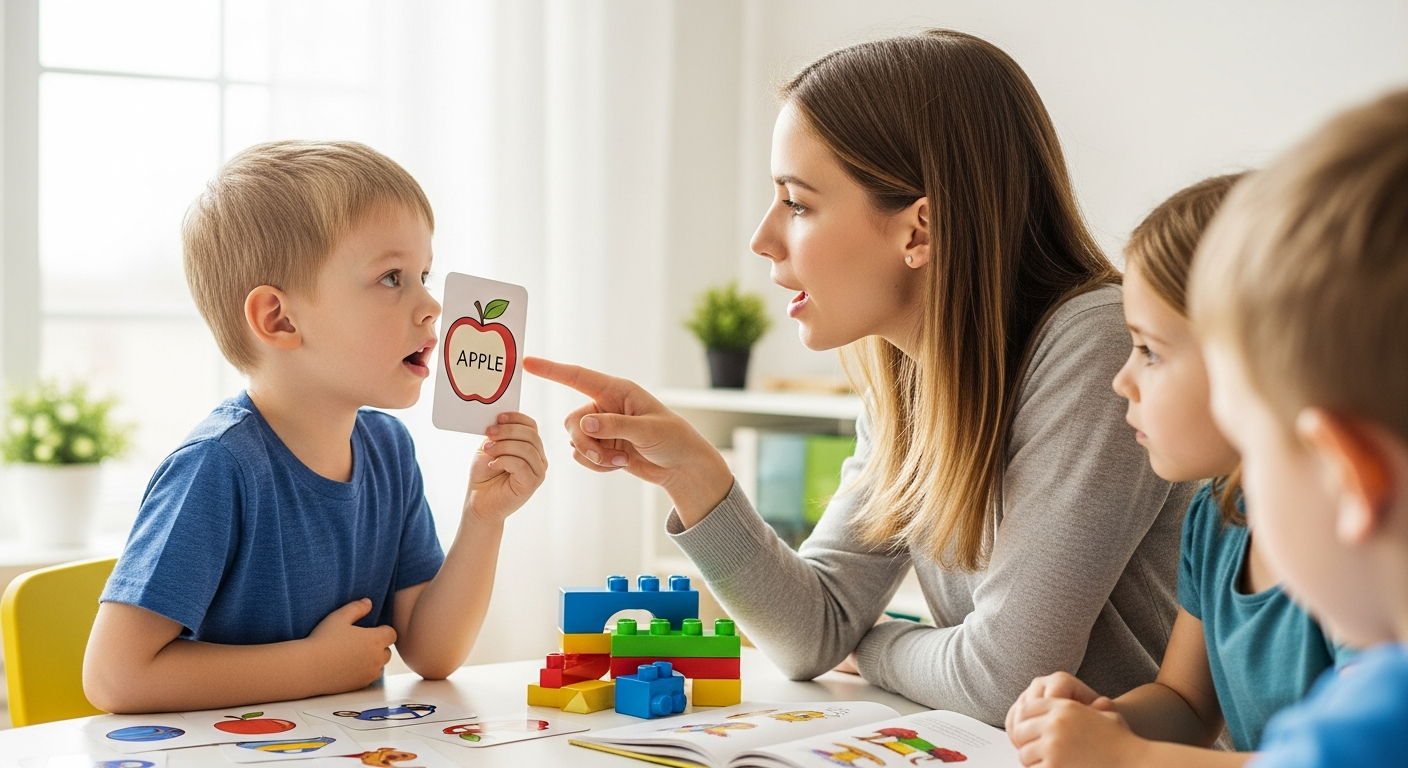
Table of Contents
- Introduction
- What Exactly is Receptive Speech Delay?
- Receptive vs. Expressive: Spotting the Difference
- Key Milestones: What to Watch For
- Common Signs and Symptoms of Receptive Speech Delay
- What Causes Receptive Speech Delay?
- The Power of Peer Video Modeling
- Practical Strategies for Supporting Your Child at Home
- The Speech Blubs Approach to "Smart Screen Time"
- Choosing the Right Plan for Your Family
- The Importance of Professional Guidance
- Creating Joyful Family Learning Moments
- Conclusion
- FAQs
Introduction
Imagine playing a game of "Simon Says" where every other child is jumping, clapping, and laughing, but you are standing perfectly still—not because you don't want to play, but because the words "Simon says touch your toes" sound like a radio tuned to the wrong frequency. For a child with receptive speech delay, the world can often feel like this. While they may have plenty to say or may be trying their best to interact, the "input" side of the conversation—the ability to understand, process, and internalize what others are saying—is where the connection breaks.
At Speech Blubs, we understand this journey intimately. Our mission is to empower children to speak their minds and hearts because our founders grew up with speech challenges themselves. They created the tool they wished they had: a joyful, effective solution for the one in four children who need extra support. In this post, we will dive deep into what receptive speech delay really is, how to spot the signs in your little one, and practical, science-backed strategies to help them navigate the world of language with confidence. We’ll explore the differences between understanding and speaking, the role of professional therapy, and how our unique approach to "smart screen time" can turn frustration into moments of family connection. By the end of this guide, you will have a roadmap for supporting your child’s comprehension and fostering a lifelong love for communication.

What Exactly is Receptive Speech Delay?
To understand receptive speech delay, we first have to distinguish between "speech" and "language." Think of speech as the physical act of producing sounds—how we use our lips, tongue, and breath to form words. Language, however, is much broader. It is the system of symbols and rules we use to share ideas. Language is divided into two main categories: expressive (what we put out) and receptive (what we take in).
A receptive speech delay occurs when a child has difficulty understanding the messages they receive from others. This isn't a problem with their hearing or their intelligence; rather, it is a challenge in how the brain processes and organizes spoken information. A child might hear the words perfectly clearly, but the meaning behind those words remains fuzzy.
For example, if you tell a toddler, "Go get your blue shoes from the kitchen," a child with a receptive delay might only catch the word "shoes" and bring you any pair they find nearby, or they might simply stare at you, overwhelmed by the multi-step instruction. They aren't being "difficult" or "disobedient"; they are simply working harder than their peers to decode the language coming their way.
At Speech Blubs, we believe that understanding is the foundation of all communication. Our methodology is rooted in the scientific principles of video modeling, where children learn by watching and imitating their peers. This peer-to-peer connection is often the "spark" that helps bridge the gap between hearing a sound and understanding its meaning.
Receptive vs. Expressive: Spotting the Difference
It is very common for parents to confuse receptive delays with expressive delays. In fact, many children have a "mixed" delay, where both areas are affected. However, understanding the distinction is vital for choosing the right support strategies.
- Expressive Language: This is the "output." It involves using gestures, words, and sentences to express thoughts and needs. If a child has trouble finding the right words or putting them in the correct order, that is an expressive challenge.
- Receptive Language: This is the "input." It involves following directions, understanding stories, identifying objects, and grasping the nuances of conversation.
Often, receptive delay is the "hidden" challenge. Because we can’t see a child thinking, we might assume they understand more than they actually do. A child who is very good at following routines might appear to understand a command like "Put your coat on," but they might just be reacting to the fact that you are holding their coat and standing by the door. If you were to say "Put your coat on" while sitting on the couch with no coat in sight, their response (or lack thereof) would give you a truer picture of their receptive skills.

If you are feeling uncertain about where your child stands, we recommend taking our quick 3-minute preliminary screener. It consists of nine simple questions that help provide an initial assessment and a next-steps plan tailored to your child’s needs.
Key Milestones: What to Watch For
While every child develops at their own pace, there are general "guideposts" that speech-language pathologists (SLPs) look for. When these milestones are missed, it may indicate a receptive speech delay.
12 to 18 Months
At this stage, children should start responding to their names consistently. They should begin to understand simple, one-step commands like "Give it to me" or "No." They should also be able to point to familiar objects or people when asked, "Where is the ball?" or "Where is Mommy?"
18 to 24 Months
By age two, most children can follow two-step related commands, such as "Pick up the toy and put it in the box." They should also be able to point to several body parts and understand the names of common everyday items (cup, bed, dog).
2 to 3 Years
In this window, comprehension expands rapidly. Children should understand simple "Who," "What," and "Where" questions. They should be able to identify objects by their use—for example, if you ask "Which one do we use to eat?" they can point to a spoon.
3 to 4 Years
By now, children should be able to follow longer, more complex instructions and understand basic concepts of size (big vs. little), color, and shapes. They should also be able to understand simple stories read aloud and answer basic questions about them.
Common Signs and Symptoms of Receptive Speech Delay
Recognizing the signs of a receptive delay early on is one of the greatest gifts you can give your child. Early intervention is not just about "fixing" a problem; it’s about reducing the frustration that comes when a child feels disconnected from their family and peers.
Here are some common signs that a child may be struggling with receptive language:
- Ignoring Direct Speech: It may seem like the child is "in their own world" or ignoring you when you call their name, even though their hearing is fine.
- Parroting (Echolalia): Instead of answering a question, the child repeats the question back to you. For example, if you ask "Do you want juice?" they respond with "Want juice?" rather than "Yes" or a nod.
- Literal Interpretation: They may struggle with figures of speech or sarcasm. If you say "Hold your horses," they might look around for actual horses.
- Difficulty with Directions: They struggle to follow instructions, especially if those instructions involve more than one step.
- Slow Response Time: There is a noticeable "lag" between when you speak and when they react, as if their brain is working overtime to decode the message.
- Disinterest in Books: They may pull away when you try to read a story or seem unable to pay attention to the narrative.
- Relying on Gestures: Because they don't fully understand the words, they rely heavily on your hand movements, facial expressions, or the physical context to figure out what you want.
What Causes Receptive Speech Delay?
It is important to remember that a delay is rarely caused by anything a parent did or didn't do. In many cases, the exact cause is unknown, but there are several common factors that professionals look into:
- Hearing Impairment: This is always the first thing to check. If a child has chronic ear infections or fluid in the ears, the sounds they hear might be muffled, making it impossible to learn the nuances of language.
- Neurodiversity: Conditions like Autism Spectrum Disorder (ASD) or ADHD can impact how a child processes sensory information, including speech.
- Developmental Delays: Sometimes speech is just one part of a broader delay in reaching physical or cognitive milestones.
- Lack of Exposure: While less common, children who aren't frequently spoken to or read to may have fewer opportunities to build their "receptive vocabulary" bank.
Regardless of the cause, the goal is always the same: to meet the child where they are and provide the "smart screen time" and personal interaction they need to grow. You can visit our homepage to learn more about how we blend these scientific principles with the joy of play.
The Power of Peer Video Modeling
One of the most effective ways to help a child with receptive speech delay is through "video modeling." But not just any video—peer-to-peer video modeling. At Speech Blubs, we use this methodology because it leverages "mirror neurons." When a child sees another child performing an action or saying a word, those neurons fire as if they were doing it themselves.
This approach is fundamentally different from passive screen time. Watching a cartoon is a "lean back" experience. Watching a peer in Speech Blubs is a "lean in" experience. For a child who struggles to understand adults (whose voices are lower and whose faces are further away), seeing a peer up close provides a relatable, non-intimidating model.
Consider a practical scenario: For a parent whose 3-year-old "late talker" loves animals, the "Animal Kingdom" section of our app offers a fun, motivating way to connect sounds to meanings. When the child sees a peer making a "moo" sound and then sees a cow appear, they are building a bridge between the auditory input (the sound) and the visual concept (the animal). This reduces the cognitive load and makes learning feel like a game.
Practical Strategies for Supporting Your Child at Home
While professional therapy is invaluable, the most important "work" happens in the small moments of your daily routine. Here are some strategies to help your child thrive:
1. Simplify Your Language
Use the "One-Up" rule. If your child is currently understanding single words, use two-word phrases. If they understand two-word phrases, use short, simple sentences. Avoid long, rambling explanations. Instead of saying, "Honey, it's time to go to Grandma's so please go find your shoes and put them on," try "Find shoes. Shoes on."
2. Use Visual Aids and Gestures
Don't just use your voice; use your body! Point to the objects you are talking about. Use signs or pictures to represent daily activities. If it’s time for a snack, show them a picture of an apple or hold up the actual apple. This provides a "visual anchor" for the spoken word.
3. Narrate Your Day
Become a "sports commentator" for your life. As you go about your chores, describe what you are doing in simple terms. "Mommy is washing the dish. Scrub, scrub, scrub. Now it's clean!" This constant, low-pressure exposure to language helps build their receptive bank without the stress of being asked to perform or answer questions.
4. Wait for the Processing
Give your child the "gift of time." After you give an instruction or ask a question, count to ten in your head before repeating yourself. Their brain might need those extra seconds to sort through the sounds and find the meaning.
5. Make it Playful
Learning shouldn't feel like a chore. Engage in "floor time" where you follow your child's lead. If they are playing with cars, join them. Use the cars to practice receptive concepts like "Stop" and "Go," or "Fast" and "Slow."
The Speech Blubs Approach to "Smart Screen Time"
We know that parents often feel guilty about screen time, but we believe that technology, when used correctly, can be a powerful tool for family connection. We call this "smart screen time." Unlike passive viewing, Speech Blubs is designed to be a co-play experience.
Our app encourages children to interact with the screen, mimic their peers, and participate in joyful learning moments. We focus on fostering a love for communication and building confidence, rather than just hitting a specific number of words. By reducing the frustration of "not getting it," we help children open up to the world around them.
Don't just take our word for it—see what other parents are saying about their child's success and the reduction in daily tantrums once their little ones began to understand the language used at home.
Choosing the Right Plan for Your Family
We are committed to being a transparent and effective partner in your child's development. To provide the best possible experience, we offer two main subscription paths:
- Monthly Plan: For $14.99 per month, you get full access to the Speech Blubs app and its vast library of activities.
- Yearly Plan: This is our best value at $59.99 per year, which breaks down to just $4.99 per month (a 66% savings!).
The Yearly Plan is the clear choice for families committed to seeing long-term progress. When you choose the Yearly Plan, you also get:
- A 7-day free trial to explore everything we have to offer.
- The Reading Blubs app, a dedicated tool to help transition from speech to literacy.
- Early access to all new updates and features.
- Priority 24-hour support response time from our dedicated team.
The Monthly plan does not include the free trial or the additional Reading Blubs app, so we highly recommend the Yearly option to ensure your child has the full suite of tools they need.
The Importance of Professional Guidance
While home activities and "smart screen time" are powerful, they are most effective when used as a supplement to professional therapy if a delay is significant. A certified speech-language pathologist (SLP) can provide a formal diagnosis and a targeted treatment plan. They can help identify if your child's receptive speech delay is isolated or part of a broader condition, such as a sensory processing disorder or an auditory processing disorder.
If you are currently working with an SLP, Speech Blubs is an excellent way to bridge the gap between sessions. You can show your therapist the app and work together to pick the "universes" (our themed activity sections) that align with your child's current therapy goals. This creates a cohesive environment for your child, where the skills they learn in a clinic are reinforced through joyful play at home.
Creating Joyful Family Learning Moments
At the heart of everything we do is the desire to help your family connect. Receptive speech delay can be exhausting for parents—you might feel like you’re constantly repeating yourself or walking on eggshells to avoid a meltdown. By using tools that engage your child’s natural curiosity and desire to imitate their peers, you can turn those moments of friction into moments of "Aha!"
Imagine the first time your child follows a complex direction without you having to point or gesture. Or the moment they laugh at a joke in a book because they finally understood the punchline. These are the victories we live for. We aren't here to promise overnight miracles; we are here to support the beautiful, sometimes slow, but always rewarding process of a child learning to "speak their mind and heart."
Conclusion
Receptive speech delay can feel like a daunting hurdle, but with the right tools, a lot of patience, and a playful spirit, your child can make incredible strides. Remember that your child’s brain is a sponge, and every simple sentence, every narrated chore, and every session of "smart screen time" is adding a new drop of understanding to their bucket.
You don't have to navigate this journey alone. We invite you to join our community of parents who are finding joy in the progress, no matter how small. Ready to take the first step? Download Speech Blubs on the App Store or the Google Play Store today.
For the best experience and the most comprehensive support, we encourage you to choose our Yearly Plan. Not only will you save 66%, but you’ll also unlock the 7-day free trial and the Reading Blubs app, giving your child a head start on their entire communication journey. If you prefer to sign up via the web, you can create your account and start your trial here.
Let's work together to help your child hear, understand, and eventually, share all the wonderful things they have inside.
FAQs
1. Is receptive speech delay a sign of Autism?
While receptive speech delay is one of the signs often associated with Autism Spectrum Disorder (ASD), having a delay does not automatically mean a child is autistic. Many children have isolated language delays that are not connected to other neurodivergent traits. If you are concerned, a comprehensive evaluation by a pediatrician or specialist is the best way to get a clear picture of your child's development.
2. Can a child outgrow a receptive speech delay on their own?
Some children are "late bloomers" who eventually catch up, but it is risky to "wait and see." Receptive language is the foundation for learning, reading, and social skills. Early intervention provides the brain with the necessary stimulation during its most plastic years. It is always better to provide support early than to try to catch up once a child reaches school age.
3. How long does it take to see progress with Speech Blubs?
Every child is unique. Some parents notice an increase in attention and imitation within the first week, while for others, it takes longer to build the habit. We focus on fostering a love for communication and reducing frustration. Consistency is key, which is why we suggest short, daily sessions of 10-15 minutes rather than long, occasional ones.
4. My child has a hearing problem; will Speech Blubs still help?
If your child has a hearing impairment, the first priority is medical treatment (like tubes or hearing aids) as recommended by an audiologist. Once their hearing is supported, Speech Blubs can be a fantastic tool to help them "catch up" on the sounds and meanings they might have missed, using the visual support of peer video modeling to reinforce what they are hearing.
About the author