
Does Pacifier Use Cause Speech Delay? What to Know
 Por Speech Blubs Team•5 mar 2026•13 min.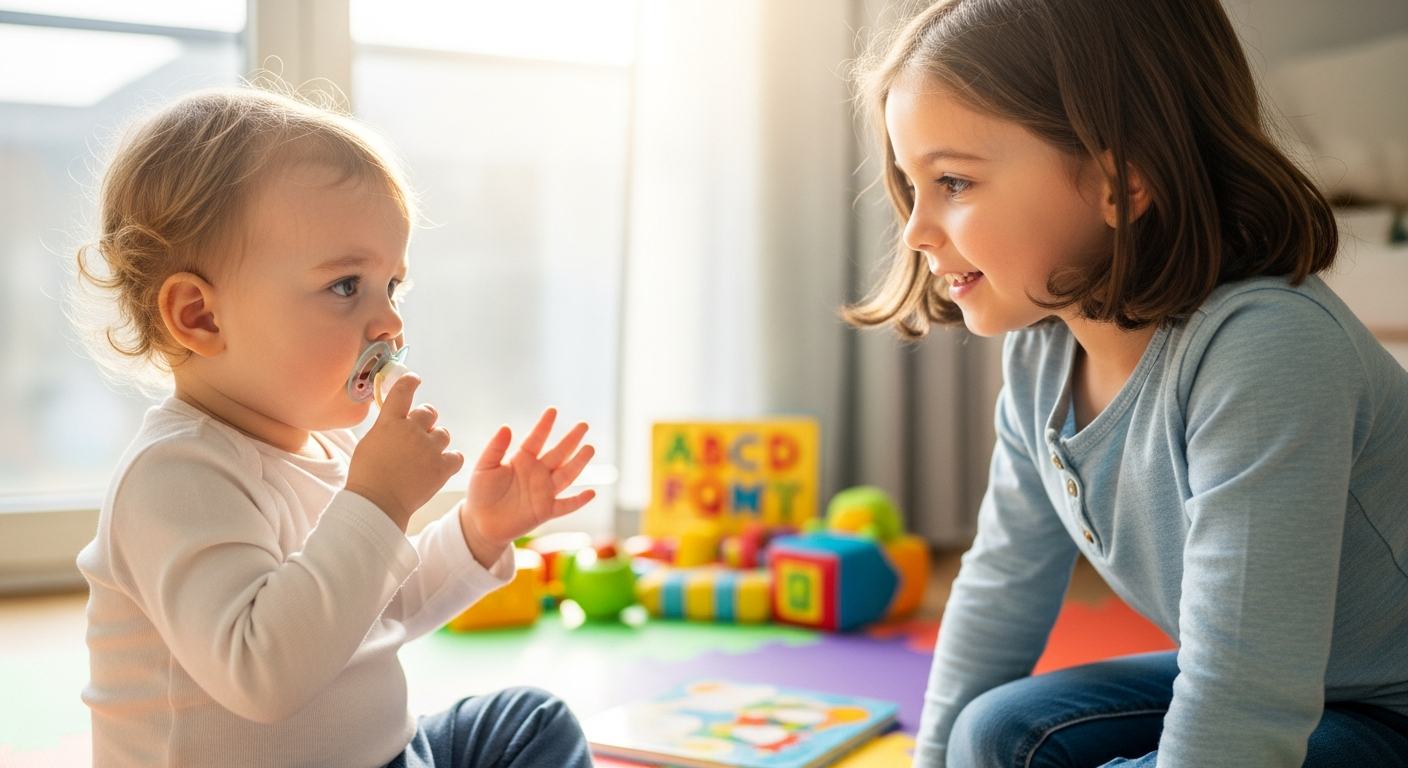
Table of Contents
- Introduction
- The Natural Urge to Suck: Why Pacifiers Exist
- Does Pacifier Use Cause Speech Delay?
- The Connection Between Pacifiers and Physical Health
- What Science Says: Video Modeling and Peer Learning
- When Should You Wean? Setting Realistic Expectations
- Making the Most of Your Child's Progress
- Practical Scenarios: Using Speech Blubs at Home
- Summary of Key Takeaways
- Frequently Asked Questions
- Conclusion
Introduction
It is 3:00 AM, and the only thing standing between you and a few more hours of precious sleep is a small, silicone "binky." For many parents, the pacifier is more than just a piece of plastic; it is a vital tool for soothing, a companion for car rides, and a reliable way to help a fussy toddler drift off to dreamland. However, as your child grows, you might start to wonder if that comforting habit is beginning to interfere with their first words. Could the very thing that brings them peace be the cause of a speech delay?
At Speech Blubs, we understand this dilemma deeply. Our mission is to empower children to "speak their minds and hearts," a goal born from the personal experiences of our founders who grew up with speech challenges themselves. We know that navigating the milestones of early childhood can be overwhelming, especially when experts offer conflicting advice about pacifier use and its impact on development.

In this article, we will dive deep into the relationship between the pacifier and speech delay. We will explore what the latest research says about oral motor development, discuss the secondary risks like ear infections and dental issues, and provide practical strategies for weaning. Most importantly, we will show you how to foster a love for communication using joyful, evidence-based tools that turn screen time into an active learning experience. Our goal isn’t to provide a one-size-fits-all rule, but to give you the empathetic expertise you need to make the best decision for your family.
The Natural Urge to Suck: Why Pacifiers Exist
From the moment they are born—and often even before that, in the womb—infants have a natural sucking reflex. This non-nutritive sucking is essential for more than just feeding; it provides a sense of security and helps regulate a baby’s nervous system.
For the first few months of life, a pacifier can be a powerful tool. It has been linked to a reduced risk of Sudden Infant Death Syndrome (SIDS) and can provide significant pain management during medical procedures or teething. At this stage, the pacifier is a "helper." It assists the infant in navigating a world that is loud, bright, and often overstimulating.
However, as a child moves into the toddler years, the function of the mouth changes. It transitions from a tool primarily for sucking to a tool for chewing and, eventually, for the complex movements required for human speech. When a pacifier remains a constant fixture in the mouth beyond the age of 12 to 18 months, it can begin to compete with these emerging developmental needs.
Does Pacifier Use Cause Speech Delay?
The question "Can a pacifier cause a speech delay?" does not have a simple "yes" or "no" answer, but rather a "it depends on how much and for how long." While occasional use for sleep typically doesn't cause major issues, prolonged and frequent use—especially during the day—presents several challenges to a child's communication skills.

1. Reduced Opportunities for Practice
Speech is a motor skill that requires practice. Think of it like learning to play an instrument; you wouldn't expect a child to learn the piano if their fingers were taped together most of the day. When a child has a pacifier in their mouth, they are less likely to babble, imitate sounds, or attempt to label the world around them.
Babbling is the foundational "gymnastics" of speech. It allows infants to experiment with their tongue, lips, and jaw to see what sounds they can produce. If the "faucet" of communication is plugged by a pacifier, these opportunities for practice are lost. Research suggests that the quality of sounds and mouth movements produced by an infant actually regulates social interactions; when a child makes a sound, the parent responds, creating a "feedback loop" that is essential for learning. A pacifier can break this loop.
2. Muffled and Distorted Speech
When a toddler attempts to talk with a pacifier in their mouth, the result is often distorted. The tongue cannot reach the proper placement for sounds like "t," "d," "n," or "s." This can lead to a habit of "mumbled" speech that becomes difficult for even the most attentive parents to understand. If this pattern persists, it can lead to frustration for the child, who may eventually stop trying to communicate altogether because they aren't being understood.
3. Impact on Oral Motor Development
The physical presence of a pacifier alters the way the mouth muscles develop. To hold a pacifier in place, the tongue must stay low and forward, rather than tucked behind the upper teeth where it belongs for many speech sounds. This can lead to a "tongue thrust" or a lisp.
If you are concerned about how your child is currently communicating, we recommend taking our quick 3-minute preliminary screener. It consists of 9 simple questions that provide an assessment and a next-steps plan to help you understand if your child's development is on track or if they might benefit from extra support.
The Connection Between Pacifiers and Physical Health
Beyond the direct impact on "talking," prolonged pacifier use can create secondary health issues that indirectly lead to speech delays.
Ear Infections and Hearing
One of the most significant risks of intense pacifier use is an increased frequency of Otitis Media, or middle ear infections. The continuous sucking motion can cause fluid to back up in the Eustachian tubes, which connect the middle ear to the back of the throat.
When a child has chronic ear infections, they often experience temporary, fluctuating hearing loss. Imagine trying to learn a new language while wearing earplugs under a swimming pool—that is what it feels like for a child with "glue ear" to try and learn speech. Because they cannot hear the subtle differences between sounds like "p" and "b," they cannot learn to produce them correctly.
Dental Malocclusion
Frequent sucking for three or more years can actually change the shape of a child's growing jaw and the roof of their mouth (the palate). This can result in:
- Open Bite: A gap between the upper and lower front teeth when the jaw is closed.
- Crossbite: The upper teeth fitting inside the lower teeth.
- Narrow Palate: The roof of the mouth becomes high and arched, leaving less room for the tongue to move freely.
These structural changes make the physical act of articulation much harder. A study by Barbosa et al. (2009) found that children who used a pacifier or sucked their fingers for three years or more were three times more likely to develop a speech disorder.
What Science Says: Video Modeling and Peer Learning
At Speech Blubs, we base our methodology on the scientific principle of video modeling. This approach is rooted in the discovery of "mirror neurons"—specialized brain cells that fire both when we perform an action and when we see someone else perform that same action.
Research shows that children are far more likely to imitate other children than they are to imitate adults. In our app, your child watches "Blubs"—real kids just like them—making fun sounds and facial expressions. This triggers those mirror neurons, encouraging your child to drop the pacifier and join in the fun. You can learn more about the research behind our method here.
For a parent whose 2-year-old is reluctant to give up the "binky" during the day, the "Early Sounds" section of Speech Blubs offers a motivating reason to speak. When they see a peer on the screen making a funny "popping" sound with their lips, the desire to imitate becomes stronger than the desire to suck. This is what we call "smart screen time"—an active, joyful alternative to passive cartoon viewing.
When Should You Wean? Setting Realistic Expectations
There is no "magic date" on the calendar, but most speech-language pathologists and pediatric dentists recommend a gradual weaning process between 12 and 18 months. By age 3, the risk of permanent dental and speech issues increases significantly.
It is important to set realistic expectations. Weaning is a process, not an event. Your child may be giving up a major source of comfort, and there may be some tears along the way. However, the benefits—building confidence, reducing frustration, and fostering a love for communication—are well worth the effort.
Strategies for a Smooth Transition
- Limit Use to "Bed and Shed": Start by restricting the pacifier to the crib or bed. It stays in the bedroom and doesn't come out for play.
- Find a Replacement: If your child uses the pacifier for anxiety, introduce a "lovey" or a soft blanket.
- The "Pacifier Fairy": For older toddlers, a ritual like giving the pacifiers to "new babies" or trading them for a special toy can provide a sense of agency and pride.
- Use Praise: When your child chooses to use their words instead of reaching for the pacifier, celebrate it! "I love how clearly you asked for your juice!"
Making the Most of Your Child's Progress
As you reduce pacifier use, you’ll notice your child has more "mouth-free" time to explore sounds. This is the perfect moment to introduce a structured yet playful tool like Speech Blubs. We provide a powerful supplement to a child's overall development plan and can be a wonderful companion to professional speech therapy.
Our users often share how seeing their child's first intentional words brought tears to their eyes. You can read some of these heartwarming testimonials here.
Why the Yearly Plan is the Best Choice
We want to provide an immediate, effective, and joyful solution for the 1 in 4 children who need speech support. To give your child the best chance at success, we recommend our Yearly Plan.
While we offer a Monthly Plan for $14.99, the Yearly Plan is just $59.99—which breaks down to only $4.99 per month. That's a 66% savings! But the value goes beyond the price.
The Yearly Plan includes:
- A 7-day free trial to ensure it's a perfect fit for your child.
- Access to our Reading Blubs app, helping your child transition from sounds to stories.
- Early access to all new updates and content.
- 24-hour support response time from our dedicated team.
Ready to get started? Create your account and begin your 7-day free trial today.
Practical Scenarios: Using Speech Blubs at Home
Let's look at how this works in real life. Imagine a 3-year-old named Leo. Leo still uses a pacifier throughout the day, and his parents have noticed he mostly points and grunts instead of using words.
His parents decide to limit the pacifier to naptime. To fill the "gap" and encourage Leo to use his mouth for something else, they sit down together and open the "Animal Kingdom" section of Speech Blubs. Leo sees a young girl on the screen making a "Moo" sound. Because he's not sucking on a pacifier, his mouth is free to move. He watches her lips, feels his own mirror neurons fire, and for the first time, he tries to say "Moo" back.
This isn't just about the word "Moo"; it's about the "joyful family learning moment" and the confidence Leo feels when he realizes he can make his voice heard. This is the power of combining weaning with active engagement.
Summary of Key Takeaways
- Moderation is Key: Pacifiers are helpful for infants, but they should ideally be phased out between 12 and 18 months to prevent speech and dental issues.
- Physical Risks: Prolonged use is linked to chronic ear infections (which impact hearing) and dental malocclusions (which impact articulation).
- Communication Barriers: A pacifier acts as a physical plug, reducing babbling, imitation, and clear speech practice.
- The Peer Connection: Children learn best by watching other children. Using video modeling tools can motivate them to use their mouths for speaking rather than sucking.
- Support Matters: You don't have to do this alone. Tools like our preliminary screener and the Speech Blubs app provide a roadmap for your child's success.
Frequently Asked Questions
1. Is it too late to stop the pacifier if my child is 3?
It is never too late to make a positive change! While some dental or speech patterns may have already started to form, stopping now will prevent further complications and allow your child to begin the "catch-up" work of practicing clear articulation. Many dental issues in early childhood can even self-correct once the sucking habit stops.
2. Can thumb-sucking cause the same speech delays as a pacifier?
Yes, thumb-sucking is another form of non-nutritive sucking that can impact speech and dental development. In some ways, it can be harder to manage because you can't "take away" a thumb. However, the same principles of redirection and using engaging tools like Speech Blubs to encourage vocalization apply.
3. Will my child's speech delay go away automatically once the pacifier is gone?
For some children, removing the pacifier leads to an immediate increase in babbling and clarity. For others, the pacifier use may have been just one factor in a broader speech delay. If you don't see progress within a few weeks of weaning, it is a good idea to consult a speech-language pathologist for a professional evaluation.
4. Does the "orthodontic" shape of a pacifier prevent speech delays?
While orthodontic pacifiers are designed to be "kinder" to the developing palate and teeth, they still occupy the mouth and limit opportunities for speech practice. They may reduce the severity of dental issues, but the behavioral impact on communication remains the same if they are used excessively.
Conclusion
The journey of raising a child is filled with "binkies" and breakthroughs. While the pacifier has its place in those early, sleep-deprived months, transitioning away from it is a vital step in helping your child find their voice. By understanding the connection between the pacifier and speech delay, you are already taking the first step toward empowering your little one.
Remember, every child's path is unique. Whether you are dealing with a "late talker" who loves animals or a toddler who needs a little extra nudge to try new sounds, we are here to support you. Our app is more than just "smart screen time"—it is a bridge to connection, built on science and fueled by play.
We encourage you to choose the best for your child's future. Download Speech Blubs on the App Store or Google Play today to begin your journey. For the best value and access to all our high-value features—including the Reading Blubs app and priority support—make sure to select our Yearly Plan. Your 7-day free trial is waiting, and we can't wait to see your child "speak their mind and heart."
Sobre el autor