
Helping Your Child With Oral Motor Speech Delay
 Por Speech Blubs Team•5 mar 2026•15 min.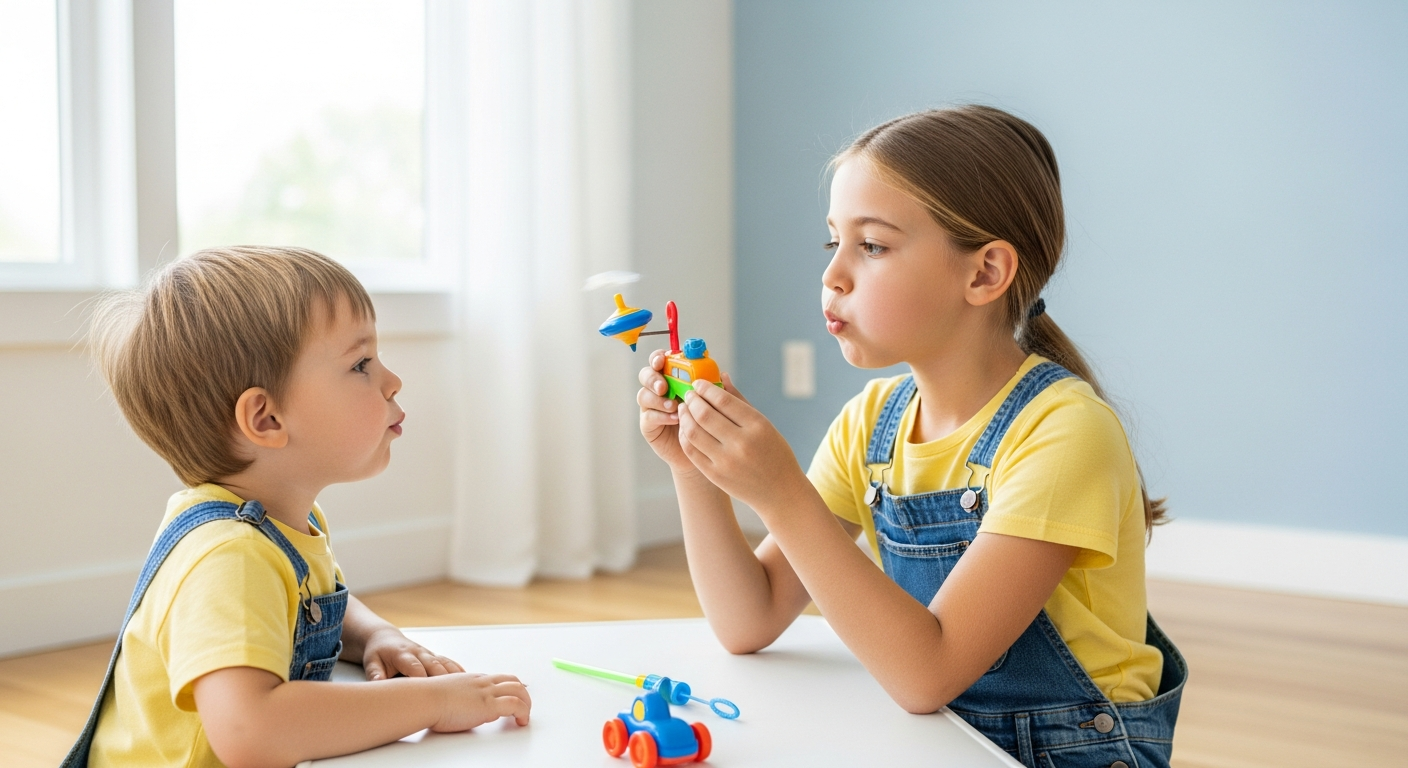
Table of Contents
- Introduction
- What Exactly Are Oral Motor Skills?
- Signs Your Child Might Have an Oral Motor Speech Delay
- The Difference Between Speech and Language Delays
- Common Causes of Oral Motor Speech Delay
- Why Hearing Matters
- Oral Motor Skills and Feeding: Why It’s Not Just About Talking
- How Speech-Language Pathologists (SLPs) Help
- The Power of Video Modeling and Smart Screen Time
- Practical Ways to Support Your Child at Home
- Empowering Your Child with Speech Blubs
- Realistic Expectations and the Power of Progress
- Conclusion
- Frequently Asked Questions (FAQ)
Introduction
Have you ever stopped to think about the incredible journey a simple "mama" or "dada" takes before it reaches your ears? It’s easy to take for granted, but speaking even one word requires the lightning-fast coordination of over 100 different muscles in the face, throat, and chest. For most children, this complex dance happens naturally. However, for about one in four children, the music doesn't quite sync up with the movement. When a child struggles to coordinate the muscles of their mouth to produce clear sounds, it is often referred to as an oral motor speech delay.
At Speech Blubs, we understand the mixture of love, concern, and occasional frustration that comes with navigating these milestones. Our mission is to empower every child to "speak their minds and hearts," a goal born from the personal experiences of our founders, who all grew up with speech challenges themselves. They built the tool they wished they had—a way to turn "hard work" into joyful play.

In this comprehensive guide, we will dive deep into what an oral motor speech delay really is, the signs you should look for, the underlying causes like apraxia and dysarthria, and practical strategies you can use at home. We’ll also explore how our unique approach to "smart screen time" can support your child’s development. Our goal is to provide you with the empathetic expertise and realistic expectations you need to foster your child’s love for communication and build their confidence, one joyful moment at a time.
What Exactly Are Oral Motor Skills?
Before we can understand a delay, we need to understand the skills themselves. While we often think of "motor skills" in terms of "gross motor" (running, jumping) or "fine motor" (writing, buttoning a shirt), oral motor skills are the precise movements of the lips, tongue, jaw, and cheeks.
These skills begin developing before a baby is even born and continue to refine until a child is about six or seven years old. They are the foundation for two of the most essential human activities: eating and speaking.
The Physical Mechanics of Speech
To speak clearly, a child needs "articulators." These include the tongue, teeth, lips, jaw, and even the roof of the mouth (the palate). An oral motor speech delay occurs when there is a breakdown in how these parts work together. This might be due to physical weakness in the muscles themselves or a "planning" issue where the brain knows what it wants to say but can't quite get the message to the mouth muscles in the right order.
If you are beginning to wonder about your child's progress, you are not alone. Many parents start their journey by seeking clarity. We recommend taking our quick 3-minute preliminary screener. It involves just 9 simple questions and provides you with an assessment and a next-steps plan to help you understand your child's unique needs.
Signs Your Child Might Have an Oral Motor Speech Delay
Recognizing a delay early is one of the greatest gifts you can give your child. While every child develops at their own pace, there are specific "markers" that suggest the oral motor system needs a little extra support.

Speech-Related Signs
- Groping for Sounds: You might see your child’s jaw or lips moving as if they are searching for the right position to make a sound, but nothing comes out initially.
- Inconsistent Errors: Your child might say a word correctly one minute and then struggle with the same word moments later.
- Vowel Distortions: While many kids struggle with consonants (like "r" or "l"), an oral motor delay often affects vowel sounds, making speech sound "flat" or "off-target."
- Difficulty with Long Words: Shorter words might be okay, but as the word gets longer (like "banana" or "hippopotamus"), the sounds get mixed up or dropped.
- Late First Words: Often, children with these delays don't start babbling until much later than 12 months or don't say their first words until well after 18 months.
Feeding-Related Signs
Because the same muscles are used for eating, an oral motor speech delay often shows up at the dinner table first.
- Excessive Drooling: Beyond the typical teething phase, constant drooling can indicate low muscle tone in the lips and jaw.
- Pickiness with Textures: A child might refuse "chewy" foods like meat or crunchy vegetables not because they don't like the taste, but because their tongue isn't strong enough to move the food around safely.
- Slow Eating or Gagging: If a child can't coordinate a swallow, they may eat very slowly or frequently cough and gag during meals.
For a parent whose 3-year-old "late talker" loves animals but struggles with these physical movements, the "Animal Kingdom" section of our app offers a fun, motivating way to practice simple "moo" and "baa" sounds. By watching other children make these sounds, your child can learn through imitation in a low-pressure environment.
The Difference Between Speech and Language Delays
It is very common for parents to use the terms "speech delay" and "language delay" interchangeably, but in the world of child development, they mean different things. Understanding the distinction helps you target the right kind of support.
- Speech is the physical act of producing sounds. It’s about articulation and muscle coordination. If your child has an oral motor speech delay, they may have wonderful ideas and a large "internal" vocabulary, but the "output" is difficult for others to understand.
- Language is about the system of communication—understanding what others say (receptive language) and putting words together to express thoughts (expressive language). A child with a language delay might be able to say words clearly but struggles to form a full sentence or follow a two-step direction.
Many children with oral motor issues also experience language delays because it is frustrating to try and communicate when your mouth won't cooperate. This is why we focus on "smart screen time" that encourages active participation rather than passive watching. You can learn more about our philosophy on our homepage.
Common Causes of Oral Motor Speech Delay
Understanding the "why" can often take the weight off a parent’s shoulders. It’s rarely about anything you did or didn't do; it’s usually a matter of how a child’s neurological or physical systems are developing.
1. Childhood Apraxia of Speech (CAS)
CAS is a neurological speech sound disorder where the precision and consistency of movements underlying speech are impaired. The muscles aren't necessarily weak, but the brain’s "operating system" for speech is glitchy. It’s like a conductor who knows the symphony but can't get the violinists to play the right notes at the right time.
2. Dysarthria
Unlike apraxia, dysarthria is caused by actual muscle weakness. This might be due to a condition like cerebral palsy or simply low muscle tone (hypotonia). A child with dysarthria might sound "breathy," "nasal," or "slurred" because their muscles physically lack the strength to close the lips or lift the tongue.
3. Physical and Genetic Factors
Sometimes, a delay is caused by structural issues like a cleft palate or a very short frenulum (tongue-tie). Genetic conditions such as Down syndrome or 22q11.2 deletion syndrome can also impact oral motor development.
Regardless of the cause, early intervention is key. We invite you to download Speech Blubs on the App Store to begin exploring activities designed by experts to help with these specific challenges.
Why Hearing Matters
You cannot learn to reproduce sounds correctly if you aren't hearing them clearly. This is why many speech-language pathologists (SLPs) will recommend a hearing test as the first step in diagnosing an oral motor speech delay. Chronic ear infections, even if they don't seem "serious," can cause fluid buildup that makes the world sound like it’s underwater. If a child hears "ball" as "pall," that’s how they will try to say it. Ensuring your child has a clear "audio signal" is fundamental to their speech journey.
Oral Motor Skills and Feeding: Why It’s Not Just About Talking
We often receive messages from parents who are surprised that a speech app or a speech therapist is asking about their child's eating habits. It’s important to remember that the mouth is a multi-purpose tool.
If a child has trouble with "bolus formation" (moving food into a little ball in the mouth to swallow), they are likely to have trouble with the complex tongue movements required for the "s" or "th" sounds. This is why "feeding therapy" and "speech therapy" are so closely linked. By working on the strength and coordination needed to chew a piece of apple, your child is actually training the same muscles they will use to tell you about their day.
How Speech-Language Pathologists (SLPs) Help
If you suspect a delay, an SLP is your best ally. They don't just "talk" to your child; they conduct a comprehensive evaluation of:
- Receptive Language: What does the child understand?
- Expressive Language: What can the child communicate?
- Oral-Motor Status: How do the lips, tongue, and jaw move together?
- Articulation: How clear are the individual sounds?
Based on this, they might use techniques like "co-production" (saying words at the same time as the child) or "video modeling." Our app is built on this very principle of video modeling, which is backed by significant scientific research. When children see other children—their peers—making sounds and movements, their "mirror neurons" fire, making it much easier for them to imitate and learn.
The Power of Video Modeling and Smart Screen Time
At Speech Blubs, we believe that not all screen time is created equal. While many apps or cartoons are passive—leading to what we call the "zombie stare"—our app is designed to be a "smart screen time" experience.
Our video modeling methodology is unique. Instead of an adult or a cartoon character, your child sees a "Blub" (a real child) performing a speech exercise. This peer-to-peer connection is powerful. It reduces the intimidation factor and makes the child think, "If they can do it, I can do it too!"
We focus on:
- Building Confidence: By starting with simple sounds and rewarding every effort, we help reduce the frustration that often comes with an oral motor speech delay.
- Fostering a Love for Communication: Our activities are designed to be "joyful," turning speech practice into a game rather than a chore.
- Family Connection: We encourage "co-play." The app is a tool for you and your child to use together, sparking conversations and shared laughter.
You can see the impact of this approach by reading testimonials from other parents who have seen their children find their voices through play.
Practical Ways to Support Your Child at Home
While professional therapy is invaluable, the most important "therapy" happens in the small moments of your daily life. Here are some simple ways to support oral motor development at home:
1. Blow Bubbles and Use Straws
Blowing bubbles is more than just fun; it’s a fantastic workout for the lips (lip rounding). Similarly, drinking through a straw—especially thicker liquids like a smoothie—requires significant jaw stability and tongue strength.
2. Play "Mouth Gym"
Make funny faces in the mirror together. Stick out your tongues, puff out your cheeks, and try to touch your nose with your tongue. This helps your child build awareness of where their "articulators" are and how they move.
3. Narrate Your Day
Talk your way through your chores. "Now, I am stirring the soup. It’s hot! Blow on it with me... whooo." This provides a constant stream of clear, simple language for your child to absorb.
4. Read Rhythmically
Choose books with lots of repetition and rhyming. Pause before the last word of a familiar sentence and see if your child tries to fill it in. Even a small sound counts as a win!
To get more structured ideas, you can download Speech Blubs on Google Play and explore our library of over 1,500 activities that turn these "exercises" into engaging games.
Empowering Your Child with Speech Blubs
We want to be transparent about how we can best support your family's journey. We offer two main ways to access our full library of expert-designed content.
- Monthly Plan: For $14.99 per month, you get full access to the Speech Blubs app and all its core features.
- Yearly Plan: For $59.99 per year (which breaks down to just $4.99/month), you receive the best possible value.
Why the Yearly Plan is our most popular choice: Choosing the Yearly plan isn't just about saving 66%. It’s about giving your child the most comprehensive toolset for success. The Yearly plan includes:
- A 7-Day Free Trial: You can explore everything we offer risk-free.
- Reading Blubs App: Access to our additional app specifically designed to bridge the gap between speech and literacy.
- Priority Support: You’ll receive a 24-hour response time from our support team to answer any questions you have.
- Early Access: Be the first to try new updates and features as we continue to grow and evolve.
Please note that the Monthly plan does not include the free trial, the Reading Blubs app, or the priority support features. We believe that speech development is a journey, and our Yearly plan is designed to be your partner for the long haul.
Ready to get started? Create your account and begin your 7-day free trial today.
Realistic Expectations and the Power of Progress
When dealing with an oral motor speech delay, it is important to set realistic expectations. Every child is a unique individual. While we provide powerful tools, we don't suggest guaranteed outcomes like "your child will be giving public speeches in a month." Speech development, especially when motor planning is involved, takes time, patience, and repetition.
Our goal is to foster the foundational skills that lead to long-term success. We focus on:
- Reducing the frustration a child feels when they can't be understood.
- Building the physical strength and coordination of the oral muscles.
- Creating "joyful family learning moments" that strengthen your bond.
Think of our app as a powerful supplement to your child's overall development plan. Whether used alongside professional therapy or as a way to jumpstart communication at home, we are here to provide the "smart screen time" that makes progress feel like play.
Conclusion
Understanding oral motor speech delay is the first step toward unlocking your child's potential. Whether your child is struggling with the motor planning of apraxia or the physical weakness of dysarthria, remember that you are your child's best advocate and most important teacher. By combining professional guidance with playful, consistent practice at home, you are laying the groundwork for a lifetime of clear and confident communication.
At Speech Blubs, we are honored to be a part of your family's story. We invite you to join our community of over 5 million parents who are turning screen time into a bridge for connection.
Take the next step today: Don’t wait to start building those vital skills. Choose the Yearly plan to get the best value, including your 7-day free trial and the exclusive Reading Blubs app. Together, we can help your child speak their mind and their heart.
Start your 7-day free trial on our website now!
Frequently Asked Questions (FAQ)
1. Is oral motor speech delay the same thing as a "tongue-tie"? Not exactly, though they can be related. A "tongue-tie" (ankyloglossia) is a physical condition where the band of tissue under the tongue is too short, restricting movement. An oral motor speech delay is a broader term that refers to any difficulty coordinating the mouth muscles for speech, which could be caused by a tongue-tie, neurological factors like apraxia, or muscle weakness like dysarthria.
2. Can my child grow out of an oral motor speech delay on their own? Generally, no. Unlike a simple "speech delay" where a child might just be a late bloomer, an oral motor delay involves the physical coordination of muscles or the brain's ability to plan movements. These issues typically require targeted exercises and therapy to resolve. Early intervention is highly recommended to prevent the child from falling behind in social and academic settings.
3. How much time should my child spend on the Speech Blubs app each day? We recommend short, frequent "bursts" of play—about 5 to 15 minutes a day. Because children with oral motor delays can get physically tired from the "muscle work" of speech, it’s better to have one joyful, high-energy session than a long, exhausting one. Consistency is much more important than duration!
4. Why does the Yearly plan include the Reading Blubs app? Speech and literacy are two sides of the same coin. Children who struggle with the physical sounds of speech often face challenges when they begin learning to read and spell those sounds. By including Reading Blubs in our Yearly plan, we provide a holistic approach that supports your child from their first words all the way through their first books.
Sobre el autor