
How PECS for Speech Delay Boosts Communication
 Por Speech Blubs Team•5 mar 2026•15 min.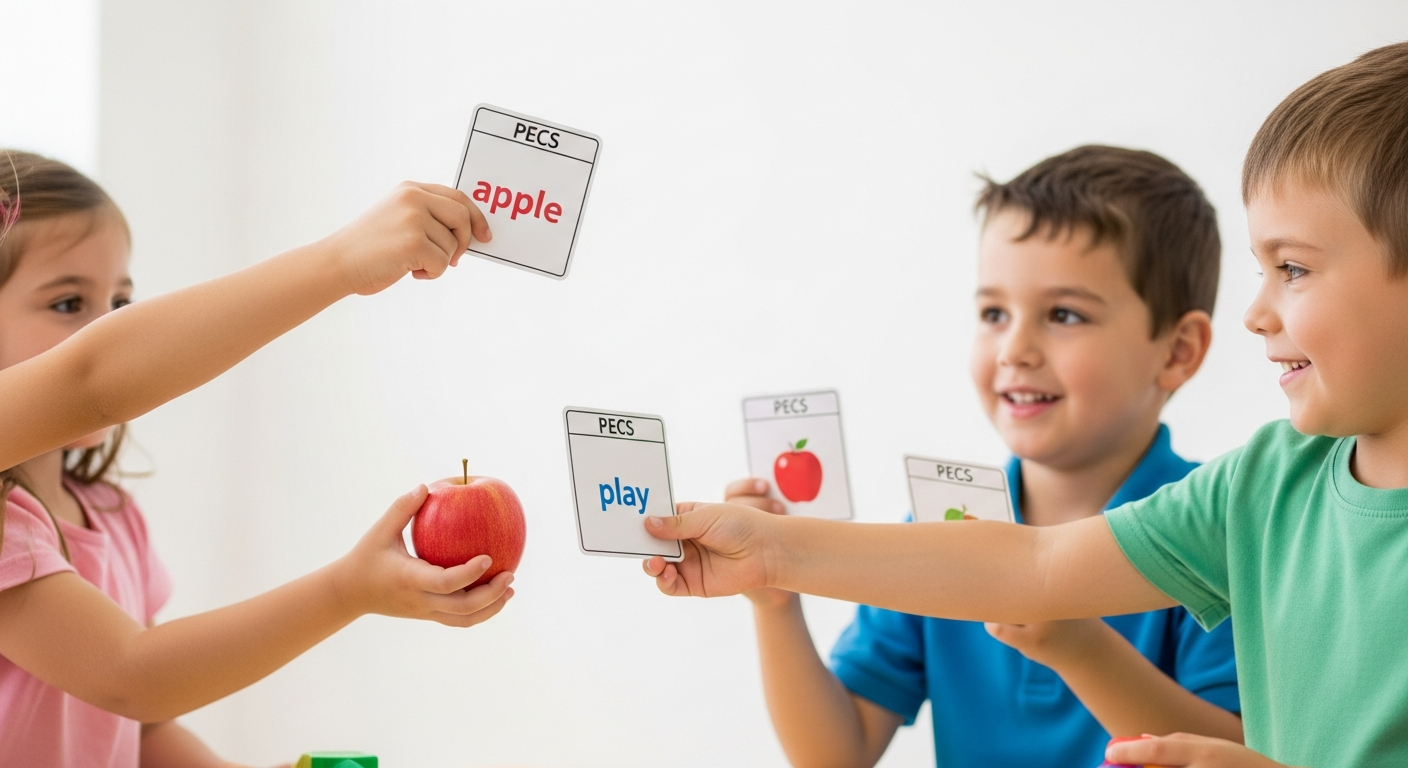
Table of Contents
- Introduction
- What Exactly is PECS for Speech Delay?
- The Six Phases of PECS
- Why PECS for Speech Delay Actually Encourages Talking
- Smart Screen Time: Pairing PECS with Speech Blubs
- The Benefits of Using PECS at Home
- How to Create Your Own PECS System
- Addressing Common Concerns About PECS
- Why the Yearly Plan is Your Best Choice
- Practical Scenarios: Bringing PECS to Life
- The Science of Video Modeling and PECS
- Realistic Expectations for Your Child
- Conclusion
- FAQ
Introduction
Imagine the sheer frustration of having a world of thoughts, desires, and needs inside your head but no way to let them out. For many children facing a speech delay, this isn't just a hypothetical scenario; it is their daily reality. When a child cannot express that they are thirsty, tired, or want their favorite blue truck, that pent-up frustration often overflows into tantrums, meltdowns, and social withdrawal. Did you know that approximately 1 in 4 children will experience some form of speech or language delay during their early development? At Speech Blubs, our mission is to empower these children to "speak their minds and hearts," providing them with the tools they need to bridge the gap between silence and connection.
The purpose of this post is to take a deep dive into one of the most effective tools used by therapists and parents alike: the Picture Exchange Communication System, or PECS. We will explore what it is, the science behind why it works, the six structured phases of implementation, and how you can use it alongside modern tools to foster your child’s growth. Whether your child is a "late talker," has been diagnosed with autism, or is struggling with apraxia, understanding how to use PECS for speech delay can be a life-changing step for your family.

By the end of this article, you will see that PECS is not a replacement for spoken language, but rather a powerful catalyst for it. Our main message is simple: by giving your child a functional way to communicate through pictures, you are actually reducing the barriers to verbal speech, building their confidence, and creating a more joyful, connected home environment.
What Exactly is PECS for Speech Delay?
The Picture Exchange Communication System (PECS) is an augmentative and alternative communication (AAC) tool developed in 1984 by Lori Frost and Dr. Andrew Bondy. While it was originally designed for young children with autism, it has since become a gold-standard intervention for anyone with significant communication challenges.
Unlike other systems that might rely on a child pointing to a picture on a board (which can sometimes be passive), PECS is rooted in the concept of exchange. The child must physically pick up a picture card and hand it to a communication partner to get what they want. This teaches the most fundamental rule of social interaction: communication is a two-way street that requires initiation.
At Speech Blubs, we resonate deeply with the "initiation" aspect of PECS. Our founders grew up with speech problems themselves and created the tool they wished they had—one that turns communication into a joyful, active experience rather than a chore. If you are curious about where your child stands in their development, you can take our quick 3-minute preliminary screener to get a simple assessment and a free 7-day trial.
The Six Phases of PECS
The beauty of using PECS for speech delay is its structured, step-by-step approach. You don't just hand a child a book of 50 pictures and expect them to know what to do. Instead, the protocol moves through six distinct phases.
Phase I: How to Communicate
In the beginning, the goal isn't even about what is on the picture. It is about the act of communication. We want the child to understand that if they give a picture to an adult, they get something they love in return.

- The Scenario: If your child loves bubbles, you would have a picture of bubbles. When the child reaches for the bubbles, you (or a second "physical prompter") help them pick up the picture and place it in your hand. The moment the picture touches your hand, you give them the bubbles.
- Speech Blubs Tip: To build interest in specific items, you might use the "First Words" section of our app. When a child sees a peer on the screen blowing bubbles, it builds that "video modeling" connection, making the physical bubble card even more enticing.
Phase II: Distance and Persistence
Once a child understands the exchange, we make it a little harder. We want them to be persistent. They might have to travel across the room to find their communication partner or go to their "communication book" to get the picture. This teaches them that they can communicate with different people in different places.
Phase III: Picture Discrimination
Now, the child learns to choose. If you give them a choice between a picture of a cracker (which they love) and a picture of a sock (which they don't care about), they have to look closely and pick the right one. This is a huge milestone in cognitive development!
Phase IV: Sentence Structure
In this phase, the child moves from single words to sentences. They use a "Sentence Strip" to build phrases like "I want [picture of apple]." This is where the foundation for grammar and more complex thought begins to take shape.
Phase V: Answering Questions
The child learns to use their book to answer the question, "What do you want?" This shifts the communication from being purely self-initiated to responding to social cues from others.
Phase VI: Commenting
This is the most advanced stage. The child isn't just asking for things; they are sharing their world. "I see a big dog," "I hear the rain," or "I feel happy." This is the ultimate goal of our mission: helping children "speak their minds and hearts."
Why PECS for Speech Delay Actually Encourages Talking
One of the biggest hurdles parents face when considering PECS is the fear that it will make their child "lazy." The logic seems sound on the surface: If my child can just hand me a picture of juice, why would they ever bother trying to say the word?
However, the scientific research behind our method and PECS research shows exactly the opposite. PECS actually lowers the pressure to perform. When a child is stressed and frustrated, the brain's "language centers" can effectively shut down. By providing a "fail-proof" way to communicate via pictures, the child’s stress levels drop.
As the child gains confidence, they often start to vocalize alongside the exchange. In Phase IV, for instance, the adult is encouraged to pause before saying the name of the object, giving the child a "gap" to fill with their own voice. Many children begin to speak their first consistent words during this stage. PECS provides the cognitive "scaffold" that spoken language eventually climbs.
Smart Screen Time: Pairing PECS with Speech Blubs
At Speech Blubs, we advocate for "smart screen time." We provide a screen-free alternative to passive viewing (like cartoons) and instead offer a powerful tool for family connection. Our app is based on video modeling, where children watch their peers perform speech exercises. This is highly effective because children are naturally wired to imitate other children.
For a parent whose child is using PECS for speech delay, Speech Blubs serves as the perfect "vocal workout."
- The Relay Effect: While your child uses their PECS book to request a snack, they can use Speech Blubs to practice the sounds associated with that snack.
- Practical Scenario: If your 3-year-old "late talker" loves animals, the "Animal Kingdom" section of Speech Blubs offers a fun, motivating way to practice "moo" and "baa" sounds. While they might use a PECS card to ask to play with their toy farm, they can use the app to gain the confidence to make the animal sounds themselves.
To see how this has worked for thousands of other families, you can read our parent testimonials. You can Download Speech Blubs on the App Store or get it on Google Play to start this journey today.
The Benefits of Using PECS at Home
Implementing PECS for speech delay isn't just about the child learning to talk; it’s about the health and happiness of the entire family unit.
1. Reducing Challenging Behaviors
When a child can’t communicate, they often resort to "behavioral communication." This means screaming, biting, or throwing things to get your attention. When a child learns that a picture exchange is faster and more effective than a tantrum, the "bad" behaviors often melt away.
2. Building Independence
Instead of you having to guess what your child wants, they can take the lead. This builds a sense of autonomy and self-worth. They are no longer a passive observer of their life; they are an active participant.
3. Improving Social Skills
PECS forces an interaction. It requires the child to find a partner, make eye contact (often naturally, as they check to see if you’ve seen the picture), and complete a social loop. These are the building blocks of friendship.
4. Portability and Accessibility
A PECS book can go anywhere—to the park, to grandma’s house, or to school. It provides a consistent "voice" for the child across all environments.
How to Create Your Own PECS System
While you can purchase official kits, many parents start with a DIY approach to see how their child responds.
- Identify Motivators: What does your child absolutely love? Is it Goldfish crackers? A specific stuffed dinosaur? A certain YouTube video? These will be your first cards.
- Take Photos: Take clear, simple photos of these items against a plain background.
- Laminate and Velcro: Print the photos, laminate them for durability (because they will be handled a lot!), and put a piece of rough Velcro on the back.
- The Binder: Get a small three-ring binder and put strips of soft Velcro on the front and inside pages. This is your "Communication Book."
- Start Small: Focus on just one or two items at first. Don't overwhelm them with a whole library of pictures on day one.
Remember, the goal is "joyful learning." If it feels like a chore, take a break and come back to it when everyone is relaxed. You can also explore our Main Homepage for more activities that complement this visual learning style.
Addressing Common Concerns About PECS
It is natural to have questions when starting a new therapy. Here are a few things to keep in mind:
- PECS is for all ages: While often used with toddlers, it is effective for older children and even adults who are non-verbal. It is never "too late" to start.
- It is not "All or Nothing": You can use PECS alongside sign language, speech therapy, and digital tools. It is just one piece of the puzzle.
- Professional Guidance is Key: While home practice is vital, working with a Speech-Language Pathologist (SLP) can help ensure you are moving through the phases correctly and not missing any subtle cues.
Why the Yearly Plan is Your Best Choice
We know that speech development is a marathon, not a sprint. Consistency is the most important factor in seeing progress. That’s why we’ve designed our subscription plans to support long-term growth.
- Monthly Plan: $14.99 per month. This is great for a quick look, but it doesn't include the full suite of our developmental tools.
- Yearly Plan: $59.99 per year. This breaks down to just $4.99/month, saving you 66% compared to the monthly rate.
The Yearly Plan is the superior value because it includes:
- A 7-day free trial to explore everything risk-free.
- Access to the Reading Blubs app, helping your child bridge the gap from speech to literacy.
- Early access to new updates and features.
- 24-hour support response time from our dedicated team.
Ready to get started? Create your account and begin your 7-day free trial today.
Practical Scenarios: Bringing PECS to Life
To truly understand the power of PECS for speech delay, let's look at how it might look in a real home.
The "Snack Time" Success Little Leo is 2.5 years old and hasn't started using words yet. He used to point at the pantry and cry until his mom guessed the right snack. After starting PECS, his mom put a picture of "Pretzels" on the front of his binder. Now, Leo walks over, grabs the picture, and brings it to his mom while she’s on the computer. She immediately gives him a pretzel and says, "Pretzel! You wanted a pretzel!" Leo is happy, and his mom is relieved. Later, they sit down together and play the "Yummy Time" section of Speech Blubs, where Leo watches other kids eat and say "Mmm!" and "Apple!" This reinforces the vocal side of the snack he just requested.
The "Park" Transition Going to the park is Sarah’s favorite thing, but leaving is always a nightmare. Her parents started using a "First/Then" board—a simplified version of PECS. "First Park, Then Home." By showing her the pictures, they reduced her anxiety about the transition. Sarah began to realize that "Home" didn't mean the fun was over forever; it just meant a different activity was coming. Using visual symbols turned a 20-minute meltdown into a 2-minute walk to the car.
The Science of Video Modeling and PECS
At Speech Blubs, we are committed to providing an immediate, effective, and joyful solution for the 1 in 4 children who need speech support. Our unique approach of teaching complex communication skills through our "video modeling" methodology is backed by the concept of mirror neurons. When a child watches another child perform an action or make a sound on a screen, their brain fires as if they are doing it themselves.
This is the perfect companion to PECS for speech delay. While PECS handles the functional side of communication (getting needs met), Speech Blubs handles the articulatory side (learning how to move the mouth, tongue, and lips). Together, they provide a comprehensive developmental environment.
Realistic Expectations for Your Child
We want to be clear: PECS is a powerful tool, but every child’s journey is unique. We do not suggest guaranteed outcomes like "your child will be giving public speeches in a month." Instead, we focus on the beautiful, small victories:
- Fostering a genuine love for communication.
- Building the confidence to try new sounds.
- Reducing daily frustration for both child and parent.
- Developing the foundational skills needed for social integration.
- Creating joyful family learning moments that replace the stress of "therapy time."
Frame the app's use and the use of PECS as a powerful supplement to your child's overall development plan. When you use these tools together, you aren't just "fixing" a delay; you are unlocking a child's potential to connect with the world.
Conclusion
Navigating a speech delay can feel like a lonely journey, but you don't have to do it alone. Utilizing PECS for speech delay is one of the most proactive steps you can take to give your child a voice. By moving through the six phases—from simple exchange to complex commenting—you are building a bridge that leads toward verbal communication and social confidence.
Remember that communication is about more than just sounds; it is about the heart. Whether your child is using a picture card or a digital app, the goal is the same: to be understood and to feel connected to the people they love.
We invite you to start this journey with us today. Choose the path of "smart screen time" and functional communication. Download Speech Blubs on the App Store or Google Play to begin. For the best possible experience, we highly recommend selecting our Yearly Plan. Not only will you save 66%, but you will also receive a 7-day free trial and access to our Reading Blubs app, ensuring your child has all the resources they need to thrive. Let’s help your little one speak their mind and heart, one picture and one word at a time.
FAQ
1. Does using PECS stop my child from learning how to talk? No. Extensive research shows that PECS does not inhibit speech. In many cases, it actually encourages vocalization by reducing the stress and frustration associated with communication. It provides a "bridge" to spoken language.
2. Is PECS only for children with autism? While PECS was originally developed for children with autism, it is highly effective for any child with a speech delay, apraxia, Down syndrome, or other communication challenges. It is a tool for anyone who needs help initiating communication.
3. How long does it take for a child to move through all six phases? Every child is different. Some may master the first three phases in a few weeks, while others may take months. The key is to move at your child's pace and ensure they have truly mastered one phase before moving to the next.
4. Can I use PECS and Speech Blubs together? Absolutely! In fact, they complement each other perfectly. PECS helps with the functional "exchange" of communication, while Speech Blubs uses peer-led video modeling to help your child practice the actual sounds and words they are requesting with their pictures.
Sobre el autor