
Speech Delay Symptoms in 2 Year Old: Signs and Next Steps
 Por Speech Blubs Team•5 mar 2026•13 min.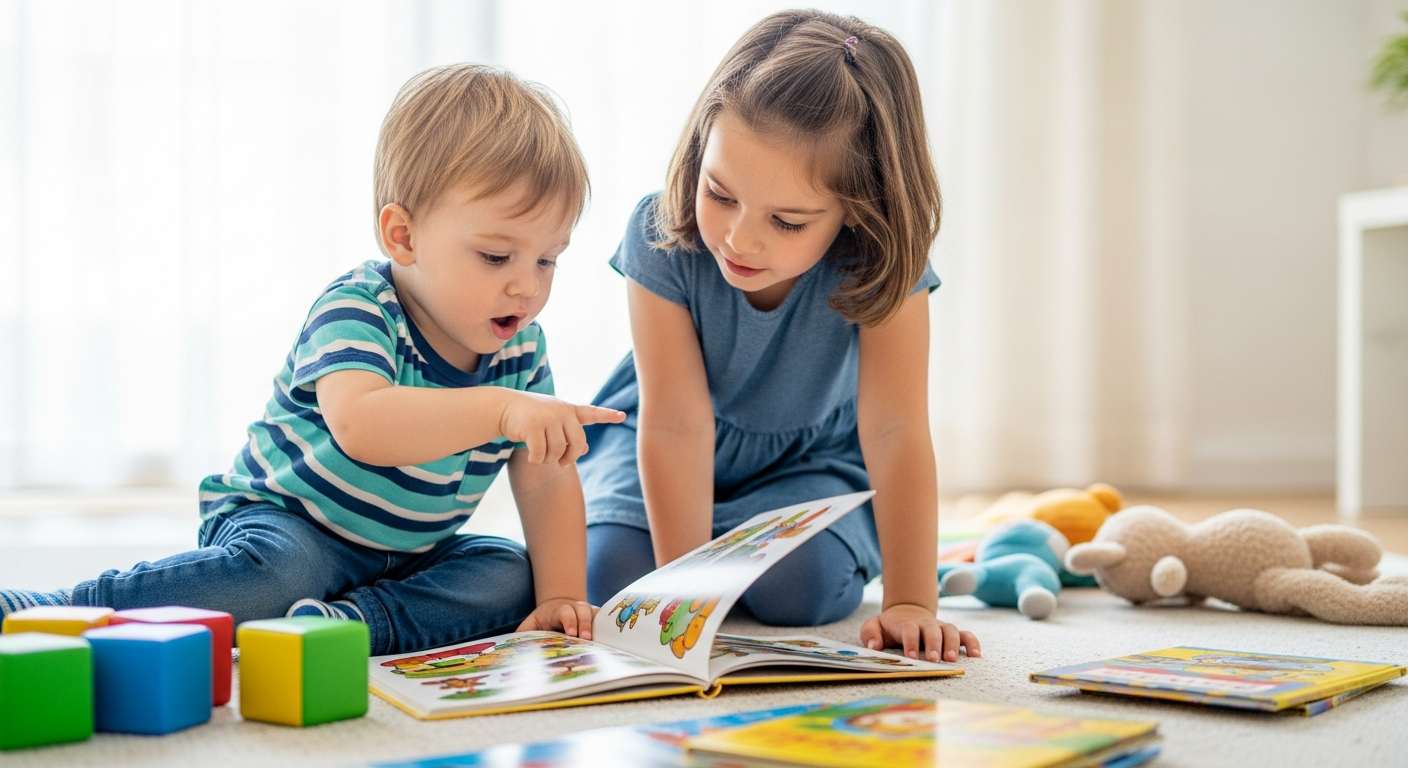
Table of Contents
- Introduction
- Understanding the Basics: Speech vs. Language
- Key Speech Delay Symptoms in 2 Year Old Children
- Common Causes of Speech and Language Delays
- The Power of Video Modeling: How Kids Learn Best
- Practical Strategies for Parents at Home
- Setting Realistic Expectations
- Investing in Your Child’s Future: Pricing and Value
- When to See a Professional
- Conclusion
- Frequently Asked Questions
Introduction
Picture this: you are at the park, and you notice a toddler roughly the same age as yours pointing at a dog and shouting, “Big doggy! Look!” Meanwhile, your own two-year-old is pulling at your sleeve and pointing silently, or perhaps letting out a frustrated grunt because they cannot find the words to tell you they want a turn on the swing. As a parent, that tiny seed of worry is natural. We find ourselves mentally checking off milestones, wondering if our little one is just a "late talker" or if there is something more significant happening.
At Speech Blubs, we understand this feeling deeply. Our company was founded by individuals who grew up with speech challenges themselves. We know that the journey to communication isn’t always a straight line, but we also know that early intervention can change everything. Approximately one in four children will need some form of speech support, and our mission is to empower these children to speak their minds and hearts through joyful, scientific, and play-based learning.

In this article, we will dive deep into the specific speech delay symptoms in 2 year old children. We will clarify the difference between speech and language delays, explore the underlying causes, and provide you with actionable strategies to support your child’s development at home. By the end of this post, you will have a clearer understanding of what "normal" looks like and when it might be time to seek professional guidance or incorporate "smart screen time" into your daily routine.
Understanding the Basics: Speech vs. Language
Before we look at specific symptoms, it is crucial to understand that "speech" and "language" are not the same thing, though they are often used interchangeably.
What is Speech?
Speech refers to the physical act of producing sounds and words. It involves articulation (how we form sounds), voice (using the vocal folds and breath to produce sound), and fluency (the rhythm of talking). If a child has a speech delay, they might be trying to communicate a complex idea but the sounds they make are difficult to understand, or they might struggle to coordinate their tongue and lips to form a specific word.
What is Language?
Language is much broader. it is the system we use to share and receive information. It includes:
- Receptive Language: Understanding what others say.
- Expressive Language: How a child uses words, gestures, and writing to communicate their thoughts.
A child with a language delay might be able to pronounce words perfectly but only be able to put two words together when their peers are using full sentences. Conversely, they might struggle to follow a simple instruction like "Bring me your shoes."
Our approach at Speech Blubs focuses on both ends of this spectrum. We use a unique "video modeling" methodology where children watch their peers on screen. This triggers mirror neurons in the brain, encouraging kids to imitate both the physical movements of speech and the linguistic patterns of language.
Key Speech Delay Symptoms in 2 Year Old Children
By the age of two, most children have moved past simple babbling and are entering a "language explosion" phase. However, if your child is exhibiting the following signs, it may indicate a delay.

1. Limited Vocabulary
By 24 months, a typical child should have a spoken vocabulary of at least 50 words. These don't have to be perfectly articulated—"ba" for ball counts! If your child is using fewer than 50 words consistently, it is a primary red flag.
2. Lack of Word Combinations
A major milestone for a two-year-old is the ability to create two-word phrases. Examples include "Mama up," "More juice," or "Big truck." If your child is only using single words to communicate their needs, they may be experiencing a delay in expressive language.
3. Preferring Gestures Over Words
While pointing and waving are important milestones for a one-year-old, a two-year-old should be transitioning toward verbalization. If your child almost exclusively relies on leading you by the hand, pointing, or grunting to get what they want rather than attempting to say the word, this is a symptom to watch.
4. Difficulty Following Simple Directions
Receptive language is just as important as speaking. By age two, a child should be able to follow one-step or simple two-step commands without visual cues. If you say, "Go get your teddy bear and put it on the bed," and your child looks confused or doesn't react, it could indicate a receptive language delay.
5. Regression of Skills
One of the most concerning symptoms is the loss of previously mastered skills. If your child was saying "Dada" and "Ball" at 18 months but has stopped using those words entirely by age two, you should consult a pediatrician immediately.
6. Unusual Tone or Clarity
While we don't expect a two-year-old to be 100% intelligible (parents usually understand about 50% of what their child says at this age), an unusual tone of voice is a sign to note. A voice that sounds consistently raspy, nasal, or "robotic" can sometimes be linked to motor speech disorders or other underlying conditions.
Unsure where your child stands? We offer a quick 3-minute preliminary screener consisting of 9 simple questions. It provides an immediate assessment and a personalized next-steps plan to help you navigate these concerns.
Common Causes of Speech and Language Delays
Understanding why a delay is happening is the first step toward effective treatment. There are several common factors that professionals look for:
Oral-Motor Issues
Many children with speech delays have difficulty coordinating the muscles in their mouth. This is often referred to as a motor speech disorder, such as Childhood Apraxia of Speech (CAS). In these cases, the brain struggles to send the correct signals to the tongue, lips, and jaw. For a parent whose child struggles with these movements, our "Face Exercises" section in the app provides a fun, low-pressure way for kids to practice making funny faces and movements that strengthen these essential muscles.
Hearing Impairments
This is often the first thing a doctor will check. If a child has chronic ear infections or undiagnosed hearing loss, they aren't hearing the sounds around them clearly. If you can't hear it, you can't imitate it. Even mild hearing loss can significantly set back language development.
Developmental Disorders
Speech delay is frequently a secondary symptom of other conditions, such as Autism Spectrum Disorder (ASD) or a general intellectual disability. In children with ASD, speech may be delayed, or they may use speech in a repetitive way (echolalia).
Environmental Factors
Sometimes, a lack of verbal stimulation can contribute to a delay. This doesn't mean a parent is doing anything wrong, but rather that the child might need a more focused, language-rich environment to "kickstart" their talking. This is where we emphasize "smart screen time." Instead of passive watching, children interact with peer models, turning screen time into a bridge for real-world connection.
The Power of Video Modeling: How Kids Learn Best
At Speech Blubs, we don't just want kids to look at a screen; we want them to look, listen, and do. Our methodology is rooted in the science of video modeling.
What are Mirror Neurons?
Research shows that when a child watches another child perform a task—like saying the word "Apple"—the same neurons fire in the observer's brain as if they were saying the word themselves. These are called mirror neurons. By using videos of real children rather than cartoons, we provide a relatable and effective model for imitation. You can learn more about the science behind our approach on our Research Page.
Real-World Success
Consider a toddler who loves animals but hasn't yet started making animal sounds. In the "Animal Kingdom" section of our app, they see a peer wearing a digital dog filter saying "Woof!" The joy and relatability of seeing another child do it often lowers the child's frustration and encourages them to try. This process builds confidence, which is the foundation of all communication. Don't just take our word for it—read the success stories from other parents who have seen their children's confidence soar.
Practical Strategies for Parents at Home
While professional therapy is invaluable, you are your child's primary teacher. Here are ways to support your two-year-old every day:
1. Narrate Your Life
Talk through everything you are doing. "I am picking up the blue socks. Now I am putting them in the basket." This constant stream of simple, clear language helps your child map words to actions.
2. Read, Read, Read
Books are a goldmine for language. Don't just read the text; point to the pictures. "Look at the big yellow bus! Vroom vroom!" Encourage your child to point to things as you name them.
3. Create "Communication Temptations"
If your child wants a snack that is out of reach, don't just give it to them when they point. Hold it up and wait a few seconds. Give them the opportunity to make a sound or try the word. If they try, celebrate wildly! If they get frustrated, model the word for them ("Cracker! You want a cracker") and then give it to them. The goal is to encourage, not to cause a meltdown.
4. Use Smart Screen Time
We know that modern parenting often involves screens. Our goal is to make that time productive. Unlike passive cartoons that can lead to "zoning out," Speech Blubs is designed for co-play. Sit with your child, mirror the peer models together, and turn the digital experience into a shared family moment.
Ready to start this journey? Download Speech Blubs on the App Store or Google Play to begin your 7-day free trial.
Setting Realistic Expectations
It is important to remember that progress takes time. Every child is unique, and speech development is a marathon, not a sprint. Using tools like Speech Blubs is not a "magic pill" that will result in a child giving public speeches in a month. Instead, it is a powerful supplement to your child's overall development plan.
Our goal is to foster a love for communication and reduce the frustration that comes when a child cannot express their needs. We want to create joyful family learning moments that build the foundational skills necessary for future success in school and social life. If your child is already seeing a Speech-Language Pathologist (SLP), our app serves as an excellent "homework" tool to keep the momentum going between sessions.
Investing in Your Child’s Future: Pricing and Value
We are committed to being a transparent partner in your child’s growth. To provide the highest quality, ad-free, and scientifically-backed content, we offer two straightforward subscription plans.
The Monthly Plan
At $14.99 per month, this plan gives you full access to our library of 1,500+ activities and peer-led videos. It is a great way to test the waters if you are just starting to explore speech support tools.
The Yearly Plan: Our Best Value
For parents committed to long-term progress, the Yearly Plan at $59.99 per year is the clear winner. This breaks down to just $4.99 per month—a 66% savings compared to the monthly rate.
When you choose the Yearly Plan, you also get exclusive high-value features that are not available on the monthly plan:
- 7-Day Free Trial: Try everything before you commit.
- Reading Blubs App: Access to our companion app designed to jumpstart literacy and phonics.
- Early Access: Be the first to try new updates and themes.
- Priority Support: A 24-hour response time from our dedicated support team.
We encourage you to create your account and begin your 7-day free trial today by selecting the Yearly plan. It’s the most comprehensive way to give your child the tools they need to succeed.
When to See a Professional
While apps and home activities are incredibly beneficial, they do not replace the expertise of a certified Speech-Language Pathologist (SLP). You should seek a professional evaluation if:
- Your child is 24 months old and has fewer than 50 words.
- Your child shows a significant regression in skills.
- You have concerns about their hearing or social interaction.
- Your "gut feeling" as a parent tells you something is wrong.
An SLP will perform standardized tests to check receptive and expressive language, sound development, and oral-motor status. Early intervention is the most effective way to ensure your child reaches their full potential.
Conclusion
Navigating speech delay symptoms in 2 year old children can feel overwhelming, but you are not alone. By staying observant, understanding the milestones, and providing a language-rich environment, you are already doing the most important work. Remember that communication is about more than just words; it’s about connection, confidence, and the ability for your child to "speak their mind and heart."
Whether your child is a "late talker" who just needs a little nudge or is facing a more complex speech challenge, tools like Speech Blubs provide an immediate, effective, and joyful solution. Our peer-led video modeling approach turns screen time into an active learning session that the whole family can enjoy.
Don't wait to give your child the support they deserve. Start your journey toward better communication today. Download Speech Blubs on the App Store or Google Play and take advantage of our 7-day free trial. We highly recommend the Yearly Plan at $59.99 to unlock the full suite of features, including Reading Blubs and priority support. Let's work together to help your little one find their voice.
Frequently Asked Questions
1. Is it normal for a 2-year-old to not be talking yet?
While every child develops at their own pace, most 2-year-olds should have at least 50 words and be starting to combine them into simple phrases like "More milk." If your child is not yet talking or has a very limited vocabulary, it is recommended to speak with your pediatrician or use a preliminary screener to determine if an evaluation is necessary.
2. Can "screen time" actually help my child's speech?
Not all screen time is created equal. Passive viewing of cartoons generally does not help with language development. However, "smart screen time" that uses video modeling—where children watch and imitate their peers—can be a powerful tool for building communication skills, confidence, and imitation.
3. What is the difference between a speech delay and autism?
Speech delay is often a symptom of autism, but it can also exist entirely on its own. Children with a speech delay only typically have strong social desires to communicate (using gestures, eye contact, and play), whereas children with autism may have additional challenges with social-emotional reciprocity and repetitive behaviors. A professional evaluation is the only way to get an accurate diagnosis.
4. How long does it take to see results from speech exercises?
Progress varies significantly based on the underlying cause of the delay and the frequency of practice. Some parents notice an increase in imitation and confidence within a few weeks of consistent, playful practice, while other children may take longer to reach major milestones. Consistency and creating a low-pressure, fun environment are the keys to success.
Sobre el autor