
Top Speech Delay Tools for Toddlers: A Parent’s Guide
 Por Speech Blubs Team•9 mar 2026•13 min.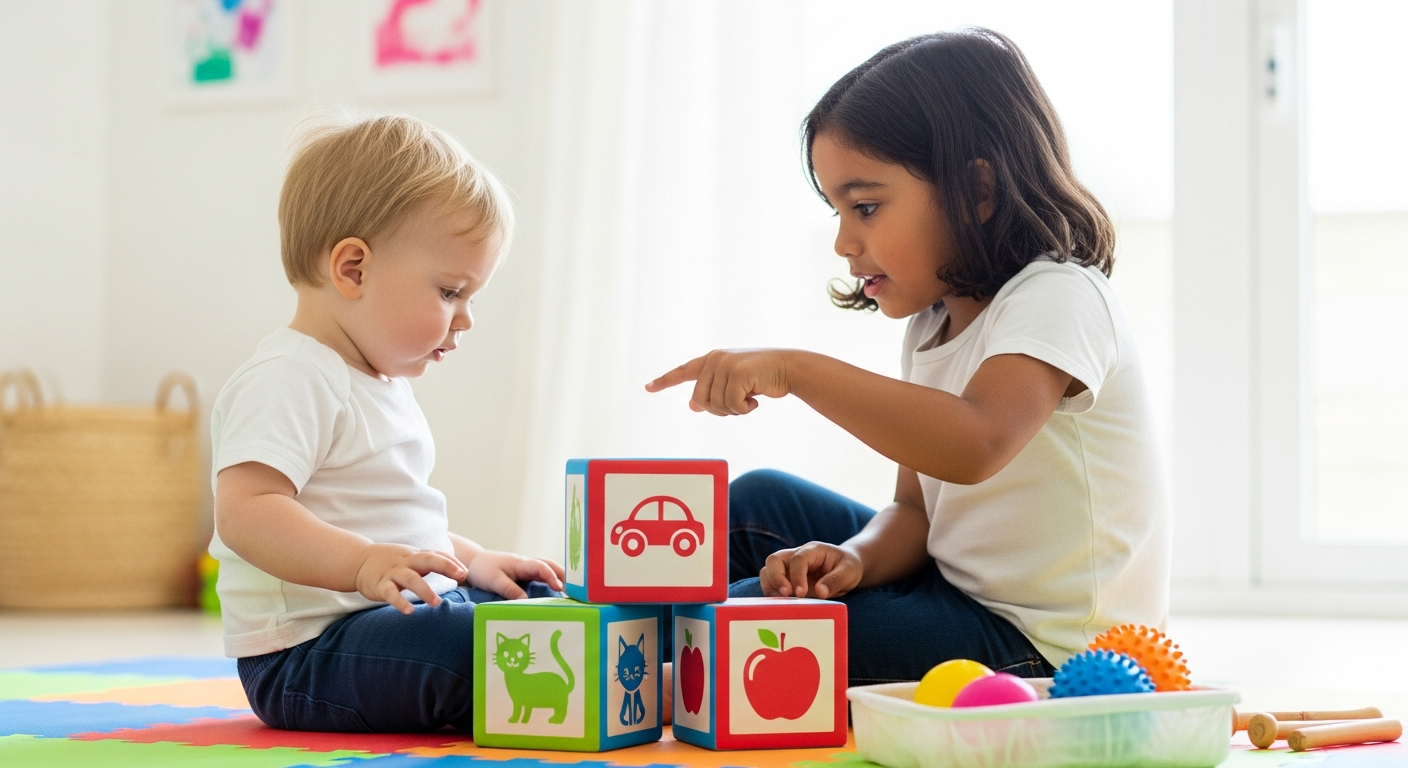
Table of Contents
- Introduction
- Why Speech Delay Tools Matter Early On
- Physical Speech Delay Tools for Home Play
- Digital Speech Delay Tools: The Rise of Smart Screen Time
- How Speech Blubs Empowers Your Child
- Practical Ways to Use Speech Delay Tools Every Day
- Understanding the Value: Choosing the Right Plan
- Setting Realistic Expectations
- Conclusion
- Frequently Asked Questions (FAQs)
Introduction
Did you know that approximately 1 in 4 children will experience some form of speech or language delay during their early development? For a parent, realizing your child isn't hitting those anticipated communication milestones can feel overwhelming, isolating, and filled with "what ifs." You might find yourself scrolling through forums or comparing your toddler to others at the playground, wondering if you should "wait and see" or take immediate action. At Speech Blubs, we believe that every child deserves the chance to speak their minds and hearts, and we know firsthand that the right environment—paired with the right tools—can make all the difference.
Our journey began from a place of deep empathy. The founders of Speech Blubs all grew up with speech problems themselves. They created this platform because it was the tool they wished they had when they were struggling to find their own voices. Today, we are dedicated to providing an immediate, effective, and joyful solution for families navigating the complexities of speech development. We don't just offer an app; we offer a way to blend scientific principles with the magic of play, turning screen time into a powerful catalyst for growth rather than a passive distraction.

In this blog post, we will explore the landscape of speech delay tools, ranging from traditional physical toys that build foundational cognitive skills to cutting-edge digital resources like our own "smart screen time" experiences. We will dive into the science of video modeling, discuss how to integrate these tools into your daily routine, and provide a roadmap for choosing the best support for your child’s unique journey. Our mission is to empower you with practical advice and realistic expectations, helping you foster a love for communication and build your child's confidence one word at a time.
Why Speech Delay Tools Matter Early On
The first few years of a child’s life are a period of incredible brain plasticity. During this window, the foundations for language, social interaction, and cognitive processing are laid down at a rapid pace. When a delay occurs, it’s not just about the words they aren't saying; it’s about the frustration that builds when a child cannot express their needs or share their world with you. This is why early intervention is so critical.
By utilizing targeted speech delay tools, we aren't just teaching a child to label a "ball" or a "dog." We are helping them understand the mechanics of communication: the back-and-forth nature of a conversation, the relationship between a sound and an object, and the power of their own voice to influence their environment. Tools provide the structure and motivation a child needs to practice these skills in a low-pressure, high-reward way.
It’s important to remember that these tools are meant to be a supplement to a child’s overall development plan and, when applicable, professional therapy. If you are feeling uncertain about your child’s progress, we always recommend taking a proactive step. You can take our quick 3-minute preliminary screener to get a simple assessment consisting of 9 easy questions and a next-steps plan tailored to your needs. This assessment also provides a free 7-day trial to help you begin your journey with confidence.

Physical Speech Delay Tools for Home Play
Long before a child speaks their first word, they are building the cognitive precursors to language. Physical toys are essential speech delay tools because they encourage sensory exploration, motor planning, and problem-solving. According to developmental experts, children in the 9-to-12-month range benefit immensely from toys that teach object permanence and cause-and-effect.
Cause and Effect Toys
A child must learn that "if I do this, then that happens." This is the cornerstone of intentional communication. When a child pushes a button on a pop-up toy and an animal appears, they are learning that their actions have consequences. This eventually translates to the realization that making a specific sound can result in getting a snack or a hug.
- Spinning Drums and Pianos: These offer immediate auditory and visual feedback.
- Push-and-Go Cars: Simple motor movements that lead to exciting movement help children stay engaged and motivated to participate in play routines.
- Bubbles: A universal favorite! Bubbles are incredible for teaching "more" or "please." By blowing a few bubbles and then stopping, you create a natural "communication temptation" where the child is motivated to use a gesture or a sound to get the fun started again.
Problem-Solving and Cognitive Growth
Puzzles and shape sorters are more than just quiet-time activities. They teach a child to discriminate between shapes and sizes, which is a precursor to discriminating between different speech sounds. For example, a Montessori ball box helps a child understand object permanence—knowing that the ball still exists even when it rolls out of sight. This mental imagery is vital for linking real-world objects to their names.
Constructive Play and Functional Use
As children move into the 12-to-18-month range, they begin to understand functional object use. This is where toys like farm sets, baby dolls, and nesting blocks become powerful speech delay tools.
- Farm Sets: These allow for endless repetitions of animal sounds ("moo," "baaa," "neigh"), which are often easier for late talkers to produce than complex words.
- Baby Dolls: Using a doll to practice "drink," "eat," or "sleep" helps a child generalize daily routines into language.
- Nesting Blocks: These are perfect for teaching prepositions like "in," "out," "up," and "down." At Speech Blubs, we love these because they allow for "joint attention"—the act of both the parent and child focusing on the same thing, which is a primary building block for learning.
Digital Speech Delay Tools: The Rise of Smart Screen Time
In an era where screens are everywhere, many parents worry about the impact of technology on language development. There is a significant difference, however, between passive viewing—like letting a child watch hours of cartoons—and "smart screen time." Smart screen time is interactive, educational, and designed to encourage participation rather than passivity.
At Speech Blubs, we have harnessed the power of digital technology to create a tool that bridges the gap between the screen and the real world. Our app isn't meant to replace human interaction; it’s designed to be a catalyst for it. We encourage "co-play," where parents sit with their children, mimicking the sounds and actions shown on the screen together.
The Power of Video Modeling
The heart of our methodology is "video modeling." This is a scientifically backed technique where children learn new behaviors by watching others perform them. However, we take it a step further: our videos feature peers—other children—rather than adults or animated characters.
Research suggests that children are more likely to imitate other children. When a toddler sees a peer making a funny face, sticking out their tongue, or saying "Pop!", their mirror neurons fire, making them much more likely to attempt the sound themselves. This peer-to-peer connection reduces the pressure and frustration often associated with speech therapy and replaces it with a sense of "If they can do it, I can too!" You can read more about the science and research behind our method to see why we are rated so highly on the MARS scale for educational quality.
How Speech Blubs Empowers Your Child
Our mission is to give every child the tools to express their hearts. We understand that every child is unique, which is why our app features over 1,500 activities across various categories. Whether your child is just starting with "Early Sounds" or working on complex "Sentence Building," we provide a structured yet joyful path forward.
Transforming Frustration into Joy
For a parent whose 3-year-old "late talker" loves animals, the "Animal Kingdom" section of our app offers a fun, motivating way to practice "moo" and "baa" sounds. Instead of a clinical drill, it becomes a game where the child watches a peer mimic a cow and then tries it themselves. The built-in voice recognition and fun face filters provide immediate, "smart" feedback that keeps children giggling and engaged.
This approach helps build confidence. When a child successfully imitates a sound and sees a silly filter appear on their own face, it reduces the frustration of not being understood. They begin to associate communication with fun and success, which is the most important foundation for long-term progress. See what other parents are saying about how this shift in attitude changed their child's development.
A Tool for Family Connection
We believe that the best "tool" a child has is their parent. Speech Blubs acts as a bridge, providing parents with the prompts and activities they need to engage with their children effectively. It’s not about handing the phone to the child and walking away; it’s about "Ready, Set, Go!" moments where you and your child are learning and laughing together. This shared experience strengthens the emotional bond and makes the learning process feel natural and safe.
Practical Ways to Use Speech Delay Tools Every Day
Integrating speech delay tools into your life shouldn't feel like another chore on your to-do list. The most effective learning happens in the "cracks" of the day—during bath time, in the car, or while waiting for dinner.
- Narrate Everything: Use the techniques you see in the app during real-life activities. If you are playing with the "Drip Drop Cups" in the bath, narrate the action: "Pouring, pouring, splash!"
- Follow Their Lead: If your child is obsessed with cars, focus on the "Whee" and "Vroom" sounds. Use the "Big Wheels" section in Speech Blubs to reinforce this interest.
- Create Communication Temptations: Don't give them everything they need immediately. If they want a snack, wait a beat to see if they will use a sound or gesture. Use the "Yummy Time" category in our app to practice the names of favorite foods.
- Consistency Over Intensity: Ten minutes of focused, joyful play with Speech Blubs or a physical toy is more effective than an hour of forced practice. Keep it light, keep it fun, and keep it consistent.
Understanding the Value: Choosing the Right Plan
We are committed to transparency because we want to build a long-term relationship with your family. We offer two main paths to accessing our library of 1,500+ activities, and we want to ensure you choose the one that provides the most value for your child's progress.
The Yearly Plan: The Best Choice for Growth
Our Yearly plan is the clear favorite for families committed to seeing progress. It is priced at $59.99 per year, which breaks down to just $4.99 per month. This is a 66% savings compared to the monthly option.
More importantly, the Yearly plan includes exclusive features that aren't available on the monthly plan:
- A 7-Day Free Trial: You can explore the entire app risk-free before committing.
- Reading Blubs App: Access to our companion app designed to help children transition from speaking to reading.
- Early Access: Be the first to try our new updates and features.
- Priority Support: Enjoy a 24-hour support response time from our dedicated team.
The Monthly Plan
For those who prefer to go month-to-month, we offer a plan for $14.99 per month. While this provides full access to the Speech Blubs app, it does not include the 7-day free trial, the Reading Blubs app, or priority support.
To give your child the full suite of tools and ensure you have the best experience, we highly recommend the Yearly plan. You can create your account and begin your 7-day free trial today to see the difference for yourself.
Setting Realistic Expectations
While we are incredibly proud of the impact Speech Blubs has had on millions of families, we want to be clear: every child's journey is different. We do not suggest guaranteed outcomes like "your child will be giving public speeches in a month." Instead, we focus on the foundational wins:
- Fostering a love for communication.
- Building the confidence to try new sounds.
- Reducing the daily frustration of being misunderstood.
- Creating joyful, bonding moments for the whole family.
Think of Speech Blubs and other speech delay tools as powerful supplements to your child's overall development. They provide the "gym" where your child can flex their communication muscles in a supportive, fun environment. Whether you are working with a professional Speech-Language Pathologist or just looking for ways to support your "late talker" at home, these tools are here to help you move forward.
Conclusion
Navigating a speech delay can be a journey filled with hurdles, but you don't have to walk it alone. From the physical "cause and effect" toys that teach the basics of interaction to the innovative "smart screen time" of Speech Blubs, there are more resources available today than ever before. By choosing tools that are rooted in science and driven by joy, you are giving your child the best possible start.
At Speech Blubs, our founders' personal experiences drive everything we do. We want to see your child succeed, thrive, and finally find the words to tell you what's on their mind. Our peer-led video modeling approach is designed to make learning feel like a playdate, not a lesson.
Are you ready to turn screen time into "speak time"? We invite you to join our community of millions of parents. Download Speech Blubs on the App Store or get it on Google Play to begin. Remember to select the Yearly plan to take advantage of the 7-day free trial, the Reading Blubs app, and the best overall value for your family. Let's start this journey together—one "moo," "baa," and "I love you" at a time.
Frequently Asked Questions (FAQs)
1. What are the best speech delay tools for a 2-year-old?
The best tools for a 2-year-old are those that encourage imitation and interaction. Physical tools like bubbles, car sets, and "cause and effect" toys are excellent for building foundational skills. Digital tools like Speech Blubs use video modeling to encourage toddlers to imitate their peers, which is one of the most effective ways for them to learn new sounds and words.
2. Can apps really help with a speech delay?
Yes, when they are designed correctly. "Smart screen time" apps that are interactive and based on scientific principles like video modeling can be very effective. Unlike passive cartoons, these apps require the child to participate, listen, and vocalize. However, apps should always be used as a supplement to human interaction and, if necessary, professional therapy.
3. How do I know if my child needs a speech delay tool?
Every child develops at their own pace, but if you notice your child isn't meeting typical milestones for their age, it's worth being proactive. A great first step is to take our 3-minute preliminary screener. It provides an assessment and a next-steps plan to help you decide how to best support your child's communication journey.
4. What is video modeling and why does Speech Blubs use it?
Video modeling is a teaching method where children learn by watching a video of someone performing a task or making a sound. Speech Blubs uses "peer video modeling," where children watch other kids. This is powerful because toddlers are naturally more interested in and likely to imitate their peers, which triggers mirror neurons in the brain and makes learning to speak more engaging and less intimidating.
Sobre el autor